
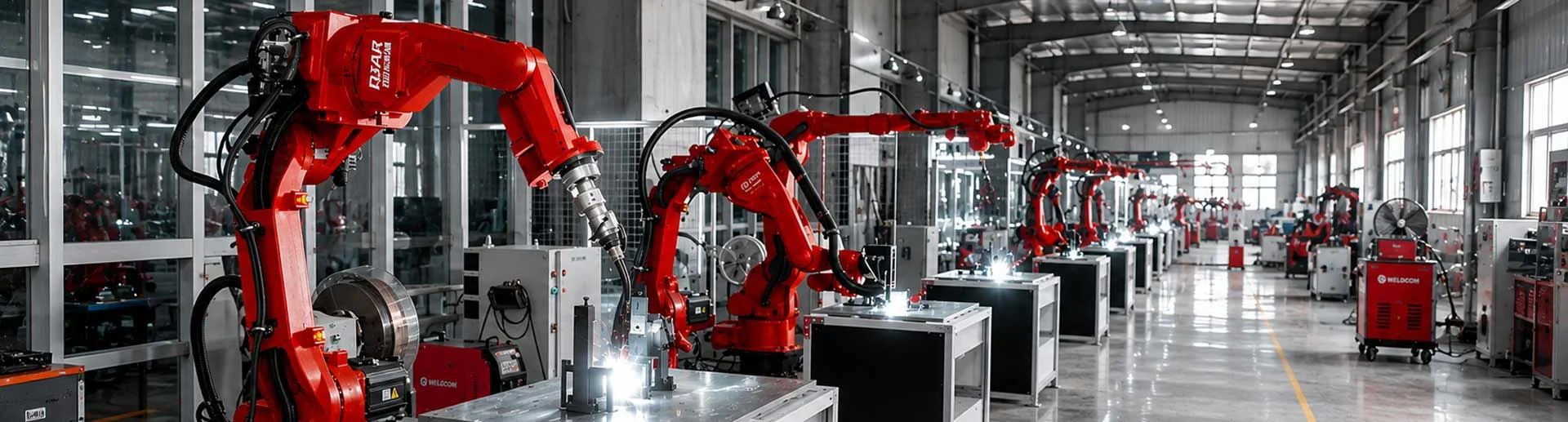
Welding Robot
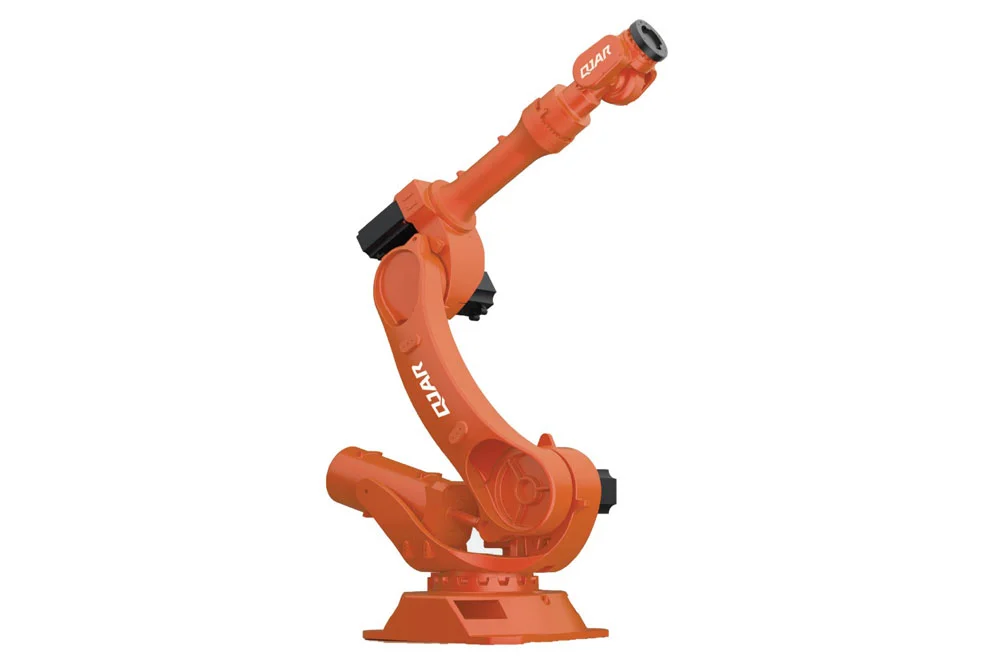
Compact design, large working space. Flexible installation in various positions. Load capacity of 210 kg, maximum robot reach up to 2.68 m. Fast response capability, high precision. Applications in ...
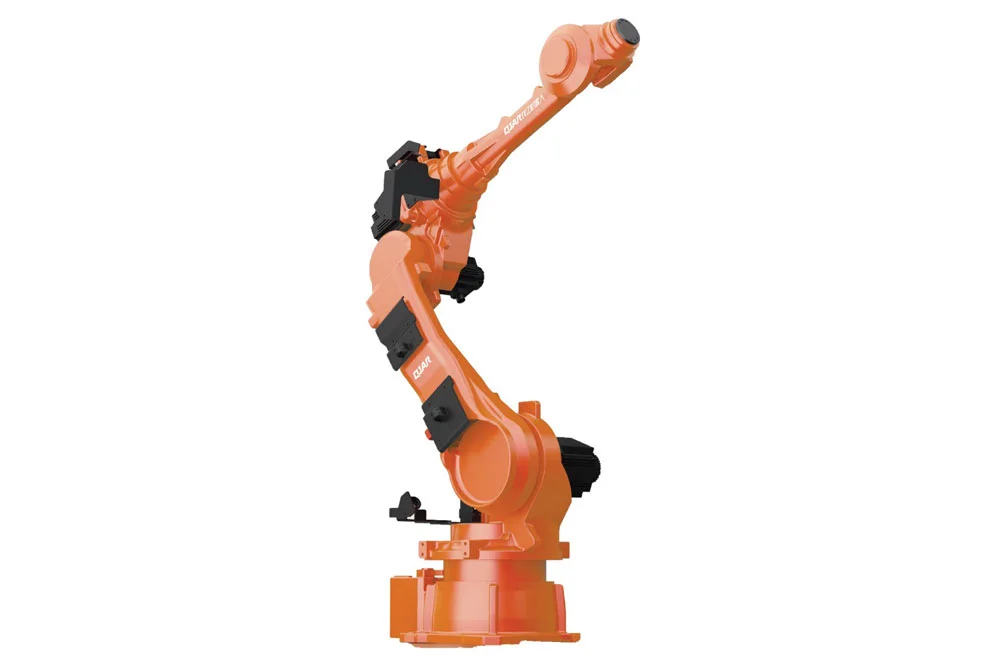
Compact design, large working space. Flexible installation in various positions. Load capacity of 50 kg, maximum robot reach up to 2 m. Fast response capability, high precision. Applications in ...
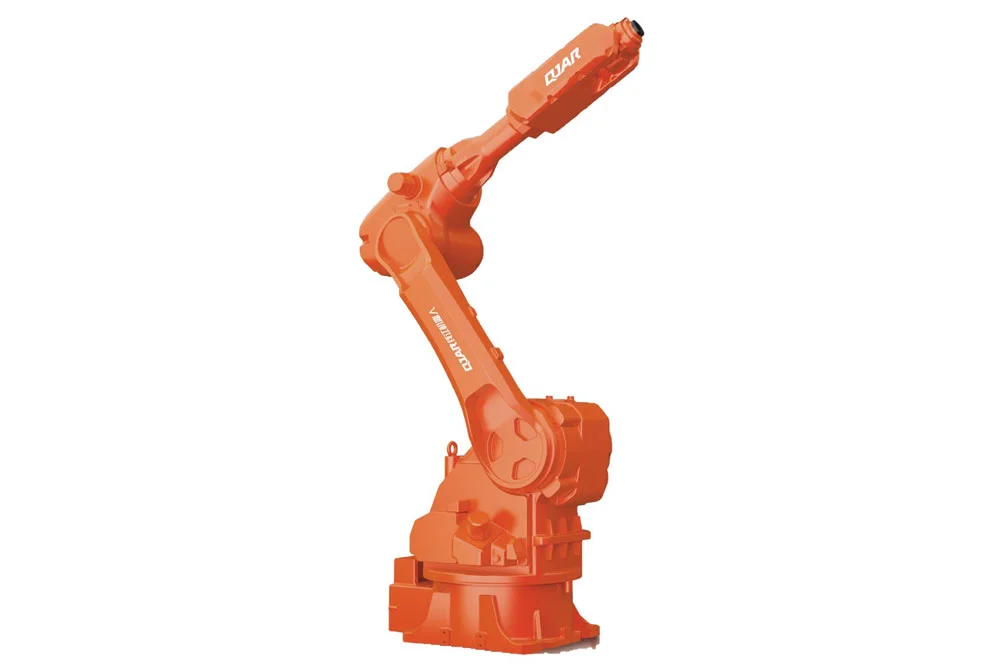
Compact design, large workspace. Quick response capability, high accuracy. Applications in loading and unloading, laser cutting, painting, polishing, and many other applications.
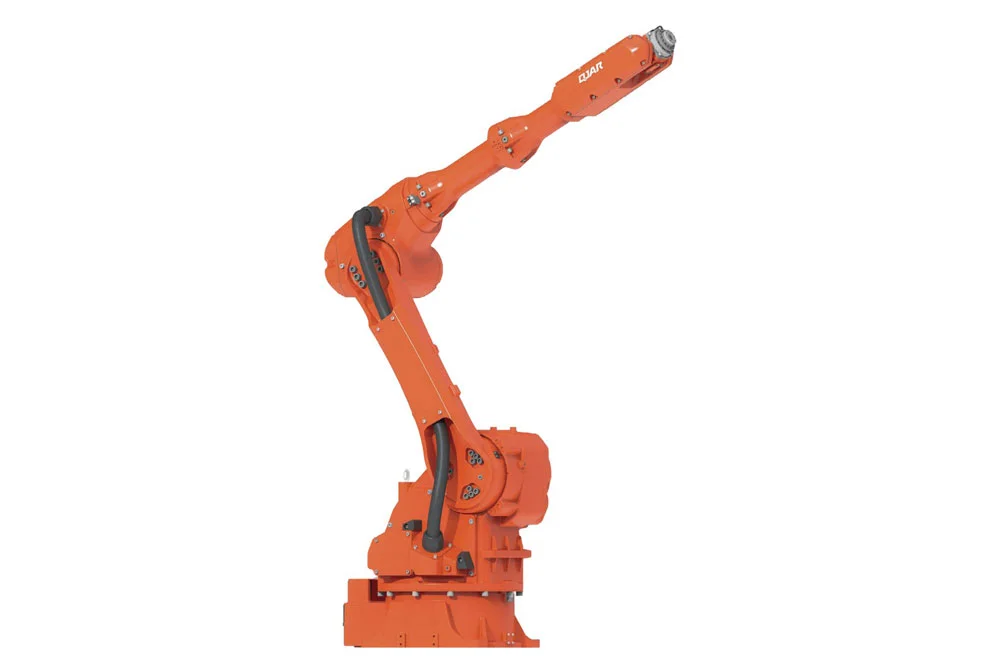
The robot structure has high rigidity to maintain accuracy during operation. The robot has a closed design with IP65 protection level. Uses corrosion-resistant screws and contact accessories. The ...
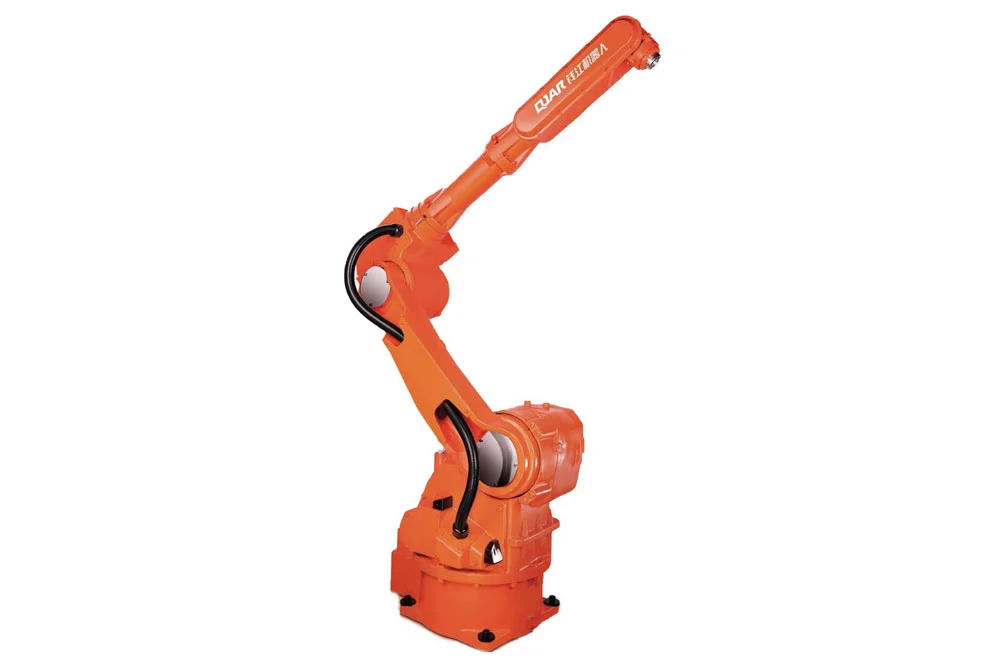
Compact design, large working space. Flexible installation in various positions. Load capacity of 10 kg, maximum robot reach up to 2 m. Fast response capability, high precision. Applications in ...
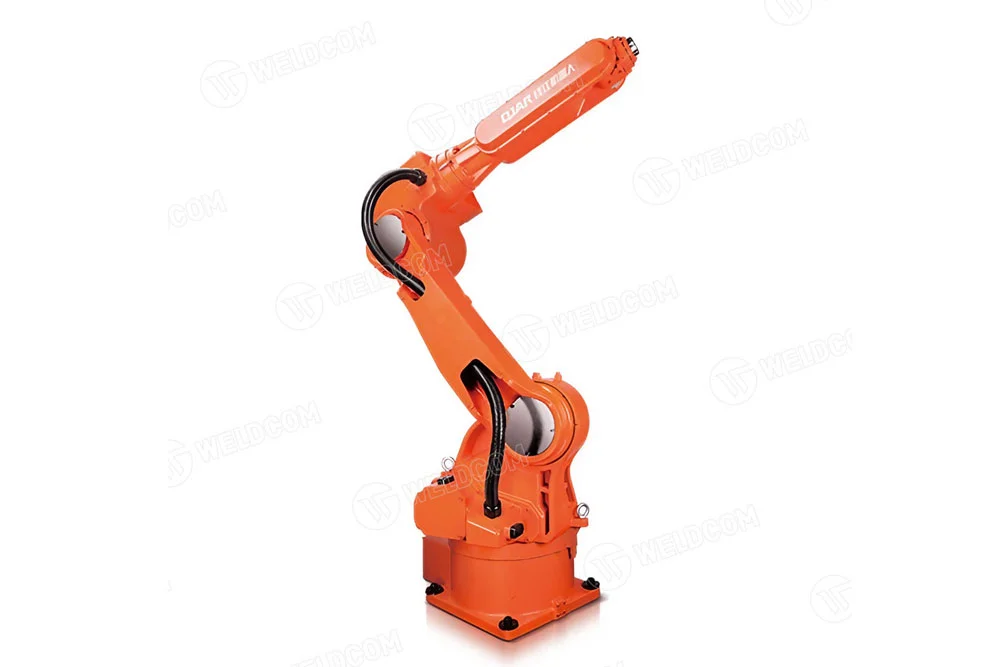
Compact design, large working space. Flexible installation in many positions. Load capacity of 10 kg, maximum robot reach up to 1.67 m. Fast response capability, high precision. Applications in ...
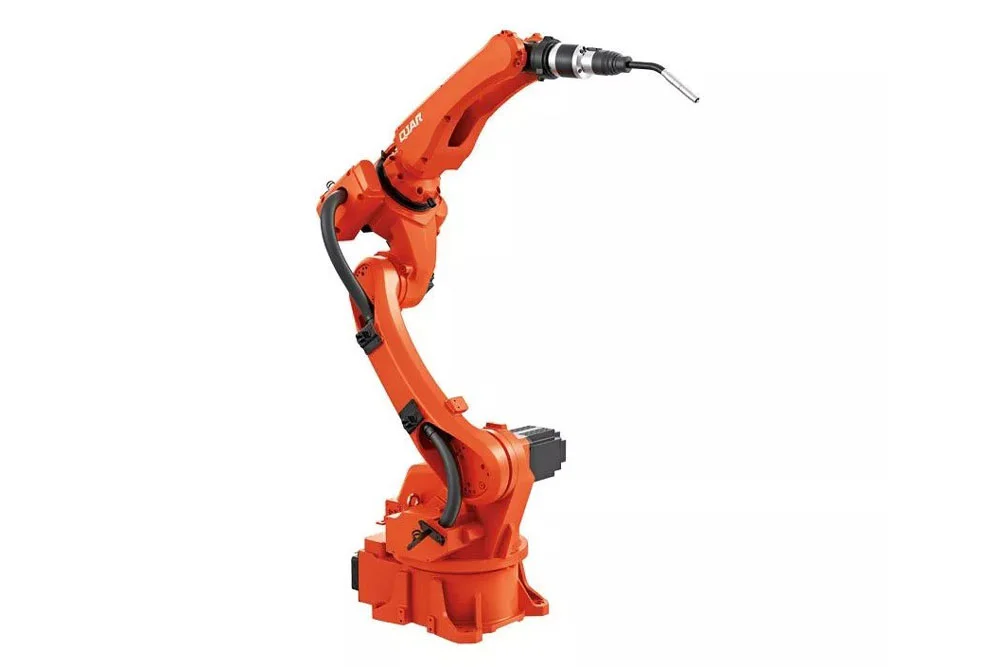
Compact design, large working space. Quick response capability, high accuracy. Wrist and arm of the robot are optimized for operation in confined working spaces. Robot is integrated with a protective ...
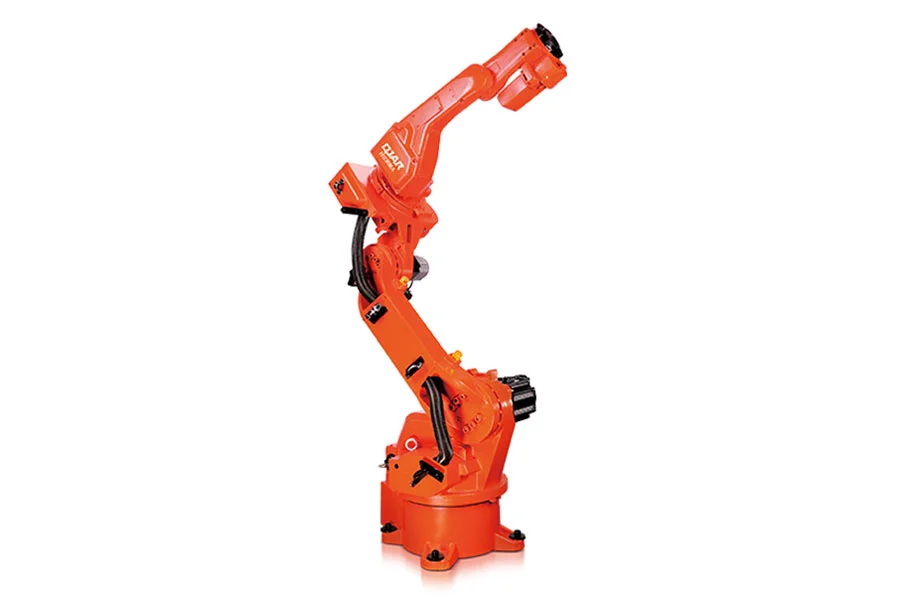
Compact design, large working space. Fast response capability, high accuracy. The wrist and arm of the robot are optimized for operation in confined workspaces. The robot is equipped with a protective ...
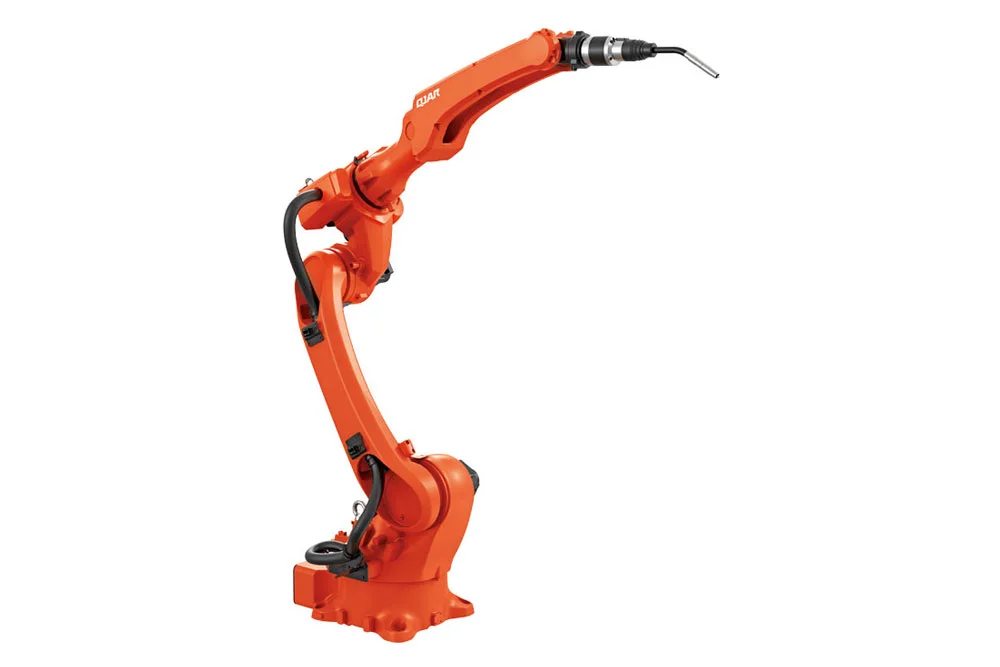
The hollow structure of the 4th axis uses a double angular contact axis, replacing the traditional structure. Axes 4 and 6 have gear clearance adjustment components to increase accuracy. The robot ...
Welding robots from Weldcom are a system that combines a robotic arm, welding gun/torch, welding source, sliding rail, sensors, fixtures, and control software to create stable welds and reduce reliance on the welder's skill automatically.
According to the International Federation of Robotics, in 2024, the world will install about 542,000 industrial robots, more than double the number from 10 years ago. The metal and machinery industry alone will install 88,777 industrial robots in 2024, an increase of 16% and reaching a new high.
1. What is a welding robot?
Welding robots are a type of industrial robot with the main function of welding, controlled automatically by pre-programmed software.
Weldcom's welding robots go beyond selling individual devices by providing comprehensive integrated solutions.
Depending on the product to be welded, Weldcom can configure a 7-axis rail welding robot station, an 8-axis cantilever welding robot station, a 9-axis cantilever welding robot station, a T-type welding robot station, or a smart cobot welding station.
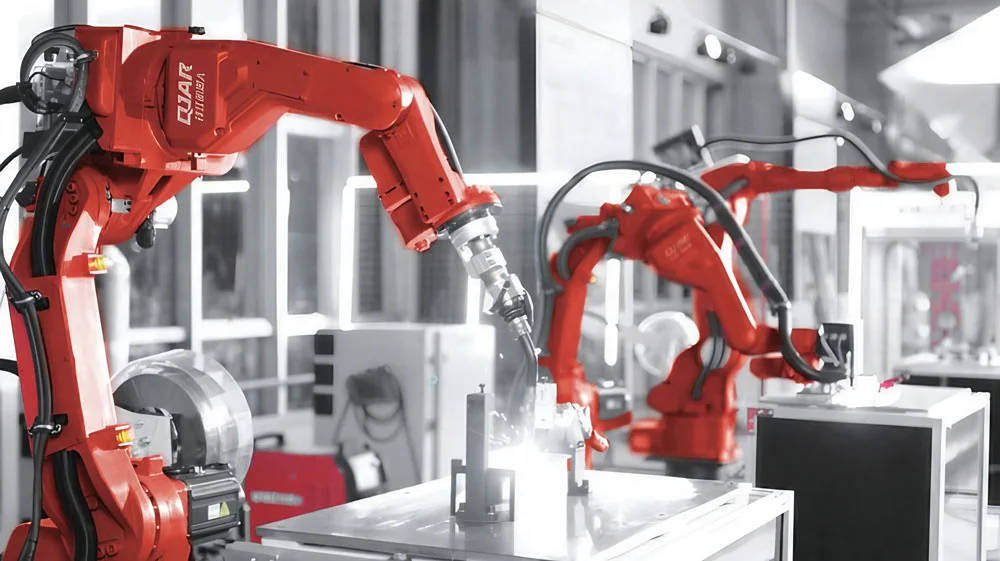
2. Advantages of Weldcom industrial welding robots
Weldcom industrial welding robots automate the welding process, helping businesses:
Increase productivity
- For products requiring repetitive welds, welding robots operate according to pre-programmed software, saving production time.
- However, businesses need to understand that investing in welding robots does not automatically increase productivity; it also depends on each case. For businesses producing small quantities with frequent changes, careful calculation is needed to avoid wasteful investment.
Stabilize weld quality
Thanks to operating according to a fixed, detailed program from welding current, voltage to welding angle or travel speed, products have consistent, stable quality. Compared to manual welders, robotic welding excels when working for extended periods.
Reduce reliance on skilled welders
Finding skilled welders to ensure welding quality is not easy, and a lack of labor resources prevents businesses from expanding production or fulfilling orders. Therefore, using welding robots helps businesses solve this issue.
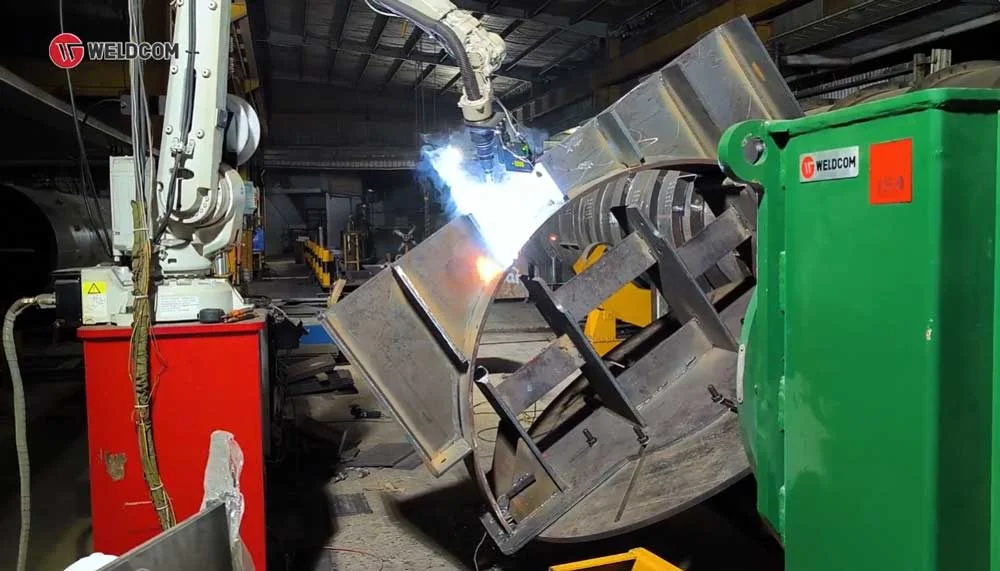
Improve labor safety
- Welding involves risks such as toxic welding fumes affecting welders' health, ultraviolet rays, burns, electric shocks, and eye injuries.
- Welding robots help reduce the time workers are directly exposed to arcs, heat, welding fumes, and harsh environments. Workers must then comply with safety regulations to ensure the best health.
Suitable for large-sized products
- For products with particularly large sizes such as H-beams, box beams, panels, ship components, bridge components, or heavy steel structures, manual welding faces many challenges.
- Using Weldcom's cantilever welding robot lines offers superior efficiency by reducing movement operations, machine downtime, and the risk of deviations between stages.
3. Structure of a welding robot
A complete Weldcom welding robot solution includes a robotic arm, welding source, welding gun, wire feeder, sensors, fixtures, sliding rail or cantilever structure, and a controller. These components work together for the robot to determine the weld position, control the weld path, and maintain stable welding parameters.
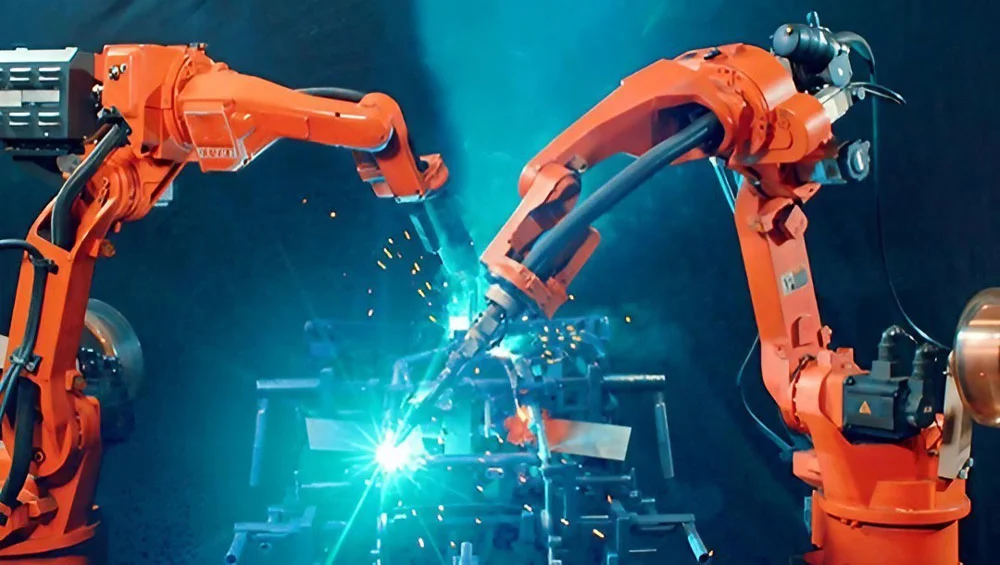
Robotic arm
The robotic arm positions the welding gun at the required welding location. Depending on the configuration, the robot can access flat welds, corner welds, vertical welds, wrap-around welds, or curved welds.
Controller
The controller inputs pre-programmed software, responsible for controlling movement, welding programs, paths, speed, stops, and how the robot's components coordinate with each other.
Welding source
The welding source provides current and voltage to create the arc. In Weldcom's welding robot stations, welding technology can include MIG/MAG, submerged arc, or other configurations depending on the production requirements of the business.
Welding gun and wire feeder
- The welding gun (or torch) is the component that directly creates the weld.
- The wire feeder feeds the welding wire into the arc at a stable speed, suitable for the welding current and the robot's travel speed.
Sensors, cameras, and scanning systems
- Sensors, cameras, or scanning systems help the robot identify workpiece deviations, weld positions, or actual profiles before welding.
- This component is extremely useful, especially for large-sized products.
Fixtures, sliding rails, and cantilever structures
- Fixtures help hold the workpiece in the correct position during welding.
- Sliding rails are components that help the robot move along the product
- Cantilever structures help expand the working area horizontally and vertically.
4. Weldcom automatic welding robot lines
Weldcom provides various automatic welding robot configurations for different application groups.
Comparison table of Weldcom welding robot lines
Weldcom welding robot line | Welding technology | Number of axes | Reference working size | Suitable applications |
7-axis rail welding robot station | MIG/MAG, submerged arc | 7 | 8 x 1 x 0.5 m | H-beams, cross columns, box beams, multi-layer welding |
8-axis cantilever welding robot station | MIG/MAG | 8 | 12 x 3.5 x 0.5 m | Shipbuilding, panels, flat welds, corner welds |
9-axis cantilever welding robot station | MIG/MAG | 9 | 12 x 3.5 x 1.5 m | Large panels, high structures, multi-position welds |
9-axis T-type cantilever welding robot station | MIG/MAG | 9 | 12 x 3.5 x 1.5 m | Double-sided welding, space optimization, panels, and large structures |
Smart cobot welding station | Depending on configuration | Depending on configuration | According to rail and actual working area | Medium workshops, multiple product codes, diverse mechanical details |
The above specifications are for reference only.
4.1. 7-axis rail MIG/MAG/Submerged arc welding robot station
- 7-axis rail MIG/MAG/Submerged arc welding robot station is suitable for heavy steel structures, box beams, multi-layer welding.
- According to Weldcom's reference configuration, the 7-axis MIG/MAG/Submerged arc robot station can handle H-beams and cross columns (thickness 16–80 mm), beam size (L x W x H) 8 x 1 x 0.5 (meters)
- The 7-axis rail welding robot can move along the product, allowing the robot to access long welds without continuously moving the workpiece. For large mass products, reducing flipping or adjusting the workpiece helps stabilize the production process.
4.2. 8-axis cantilever MIG/MAG welding robot station
- 8-axis cantilever MIG/MAG welding robot station is applied in shipbuilding, panels, and flat, bent, vertical corner welds, wrap-around welds, lap welds, and curved welds on flat surfaces.
- According to Weldcom's reference configuration, the reference working size of this line is 12 x 3.5 x 0.5 m. The wide working area helps the robot handle long panels, flat structures, and assemblies with multiple welding positions in one cycle.
- The cantilever structure is suitable when the factory needs the robot to reach over a large working area while maintaining a relatively compact layout. This line should be considered for shipbuilding lines, panel fabrication, flat steel structures, and industrial assembly.
4.3. 9-axis cantilever MIG/MAG welding robot station
- 9-axis cantilever MIG/MAG welding robot station is applied in shipbuilding, panels, flat, bent, vertical corner welds, wrap-around welds, lap welds, and curved welds on flat surfaces.
- According to Weldcom's reference configuration, the reference beam size (L x W x H) is 12 x 3.5 x 1.5 m
- The 9-axis cantilever welding robot is particularly suitable for enterprises producing large-sized products, complex profiles, or requiring access to multiple positions.
4.4. 9-axis T-type cantilever MIG/MAG welding robot station
- 9-axis T-type cantilever MIG/MAG welding robot station optimizes space and can weld on both sides. This welding robot station is applied in shipbuilding, panels, flat, bent, vertical corner welds, wrap-around welds, lap welds, and curved welds on flat surfaces.
- According to Weldcom's reference specifications, the reference working size is 12 x 3.5 x 1.5 m.
- The T-type helps increase the working area and optimize installation space.
4.5. Smart cobot welding station
- The smart cobot welding station from Weldcom combines a welding cobot (collaborative robot) with a rail system, welding source, welding gun, and controller. The cobot can then move along the rail to the required welding position.
- The welding cobot is suitable for medium and small mechanical workshops, welding machine frames, machine bases, supports, steel pallets, steel racks, industrial fixtures, machine shells, and assemblies with short or medium welds.
- The strength of the welding cobot is that it is cheaper than the more professional robot lines mentioned above, suitable for businesses lacking skilled welders but not yet needing to invest in large-scale industrial welding robot systems.
5. Applications of Weldcom industrial welding robots
Weldcom industrial welding robots are applied in many industries requiring stable welds, large-sized products, or repetitive production.
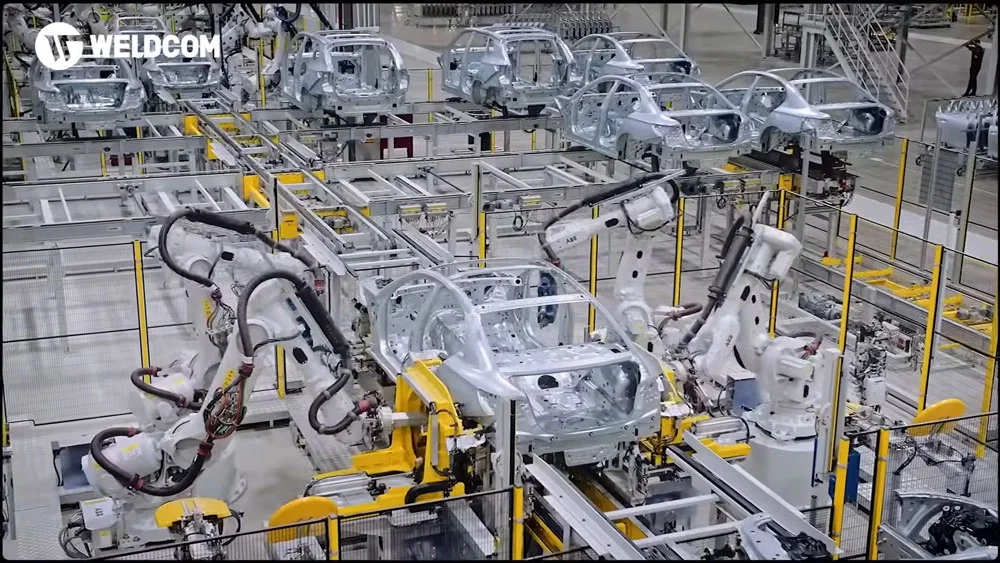
5.1. Vehicles, cars, and electric motorcycles
In the automotive and motorcycle manufacturing sector, welding robots can be used for frames, structural assemblies, supports, mechanical details, and parts requiring high repeatability. For cars and electric motorcycles, welding automation helps standardize the production process when the output is large enough.
5.2. Energy, wind power, and oil & gas
Welding robots can be applied in the fabrication of wind power components, oil & gas equipment, support frames, tanks, and heavy structural assemblies.
5.3. Shipbuilding and floating structures
Shipbuilding is a suitable application for cantilever welding robots due to the presence of many panels, long welds, corner welds, and large flat structures. Welding robots help reduce manual welding operations on repetitive weld lines, especially in panel and structural assembly production.
5.4. Industrial construction, pre-engineered steel buildings, and bridge-road structures
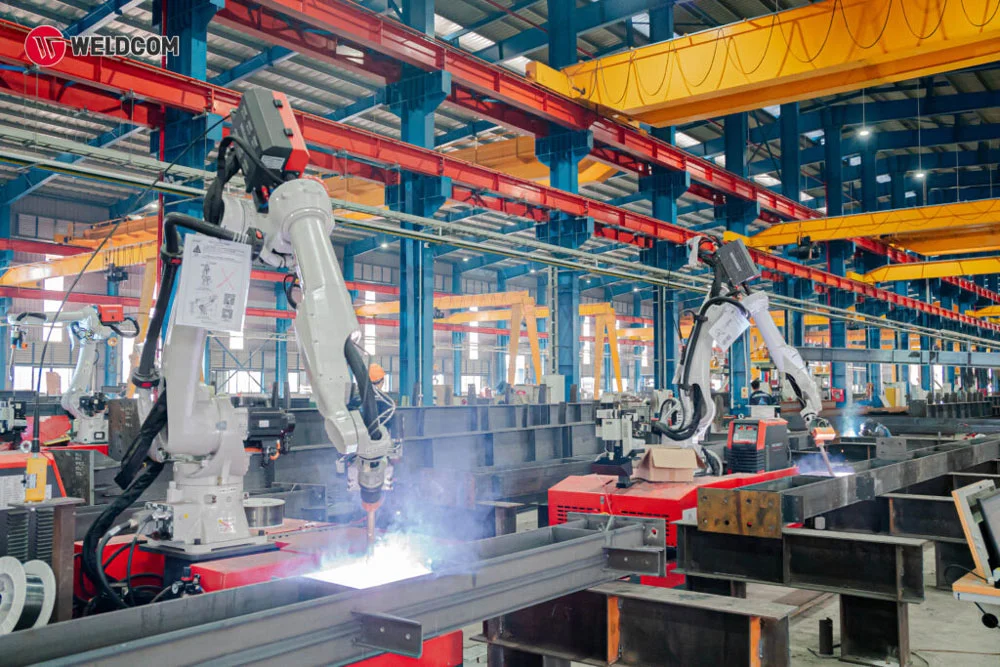
Steel structure welding robots are suitable for producing H-beams, box beams, cross columns, steel frames, bridge-road components, and pre-engineered steel structures. This product group has many long welds, large volumes, and requires stable production according to orders.
5.5. Urban infrastructure and highways
Urban infrastructure projects, urban railways, highways, and bridges use many load-bearing steel components. Welding robots can support the production of repetitive structural assemblies, beams, frames, gussets, stiffeners, and details requiring long welds.
5.6. Mechanical manufacturing, pressure tanks, and heat exchangers
Mechanical manufacturing is a broad application group, including pressure tanks, heat exchange systems, machine fabrication, machine frames, equipment shells, and industrial structural assemblies. Welding robots can be configured for linear, plate, frame, or assembly-type products.
For products with many product codes, businesses should consider welding cobots or welding robots with flexible programming software. For repetitive products, long welds, and large output, specialized industrial welding robots usually offer better investment efficiency.
6. When should businesses invest in welding robots?
- Businesses that produce products requiring long, repetitive welds or multi-layer welding.
- Businesses that cannot recruit skilled welders or have unstable product quality.
- The post-production error rate is still high.
- Products are large in size, difficult to handle manually continuously.
- Businesses need to increase output but do not want to correspondingly increase the number of welders.
- Businesses plan to automate the production process
7. Weldcom welding robot project implementation process
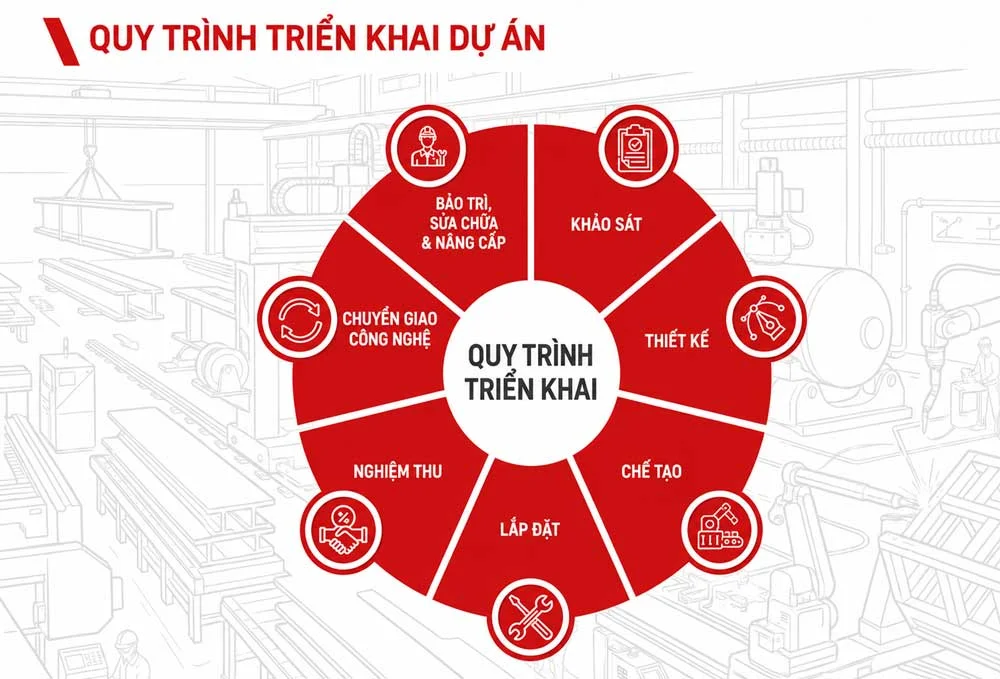
The Weldcom welding robot project implementation process consists of 7 steps: survey > design > manufacture > installation > acceptance > technology transfer > maintenance, repair, and upgrade.
8. FAQ about welding robots
8.1. What is an industrial welding robot?
An industrial welding robot is an automated system using a robot, welding source, welding gun, wire feeder, and controller to perform welds in production. This system is suitable for products with repetitive welds, large output, and stable quality requirements.
8.2. Which industries are Weldcom welding robots suitable for?
Weldcom welding robots are suitable for steel structures, shipbuilding, panels, mechanical manufacturing, energy, oil & gas, infrastructure, pre-engineered steel buildings, pressure tanks, and industrial equipment. Depending on the product, Weldcom will propose rail welding robots, cantilever welding robots, or welding cobots.
8.3. When should you choose a 7-axis rail welding robot?
A 7-axis rail welding robot is suitable for H-beams, box beams, cross columns, heavy steel structures, and products with long welds. This line is suitable when the workpiece is large, difficult to move continuously, and requires the robot to move along the product.
8.4. When should you choose an 8-axis or 9-axis cantilever welding robot?
An 8-axis or 9-axis cantilever welding robot is suitable for panels, shipbuilding, floating structures, and large plate structures. The 9-axis line is more suitable when the product has a larger height or requires the robot to access multiple complex welding positions.
8.5. How does a welding cobot differ from an industrial welding robot?
A welding cobot is more flexible, easier to guide, and suitable for workshops with many product codes. Industrial welding robots are more suitable for large products, long welds, high output, and deep automation requirements in the production line.
8.6. Can welding robots completely replace welders?
Welding robots do not completely replace welders in all cases. Robots help automate repetitive operations, but personnel are still needed to understand the welding process, fixture setup, parameter selection, quality inspection, and handle arising situations in production.
Weldcom industrial welding robots are suitable for businesses needing to automate the welding process, stabilize weld quality, and reduce reliance on skilled welders. Depending on the product, layout, and actual output, Weldcom can advise on suitable rail welding robot, cantilever welding robot, or welding cobot configurations.
Businesses needing more information or wanting to survey welding robot solutions can contact Weldcom via hotline or fill in information to receive detailed consultation.
Consulting support