
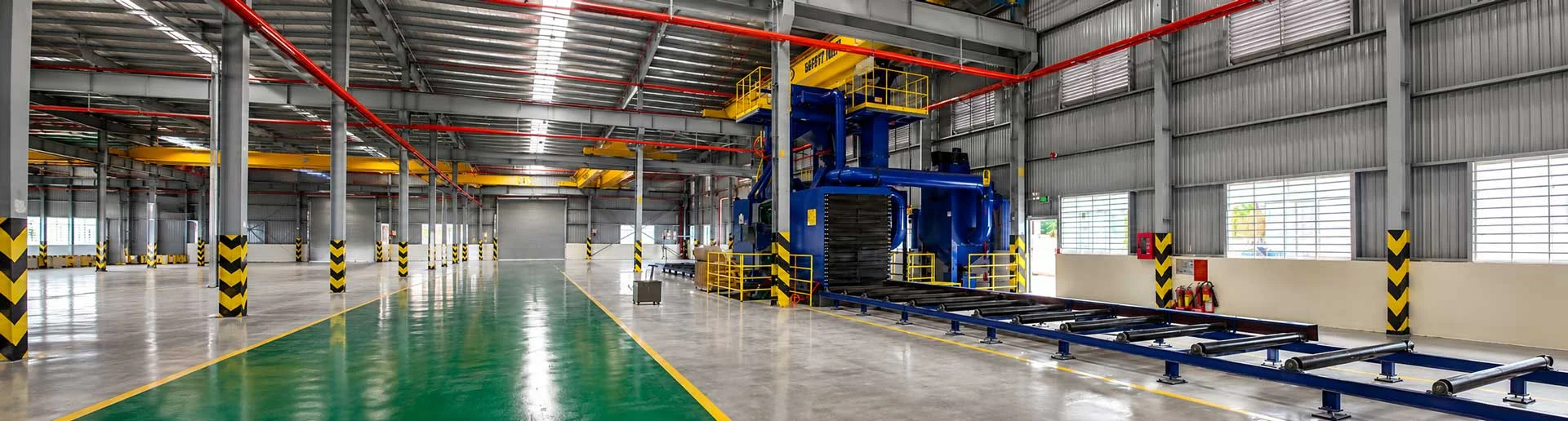
Shot blasting machine
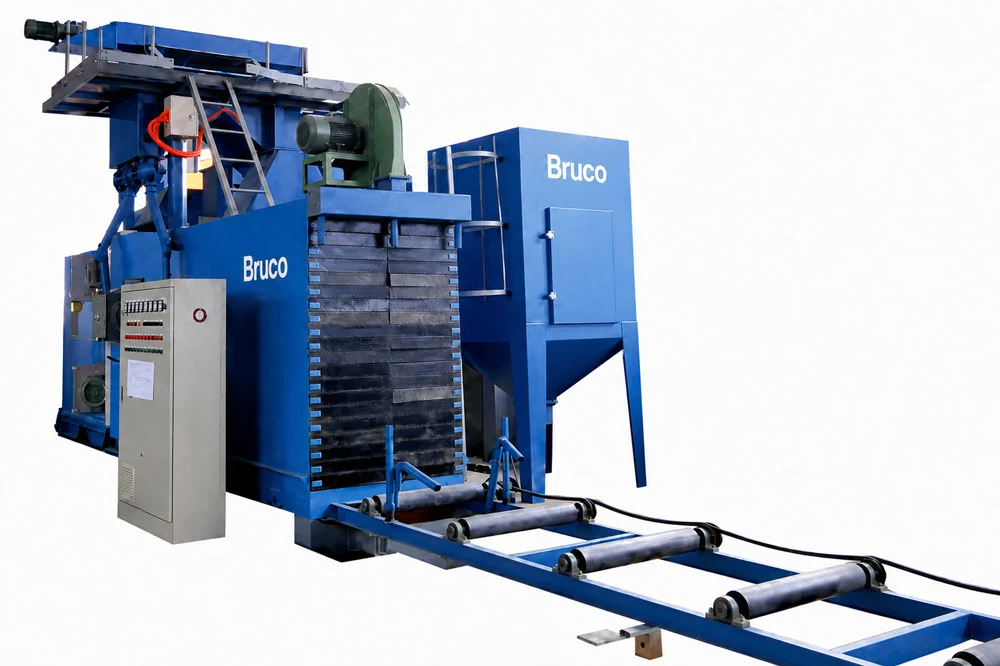
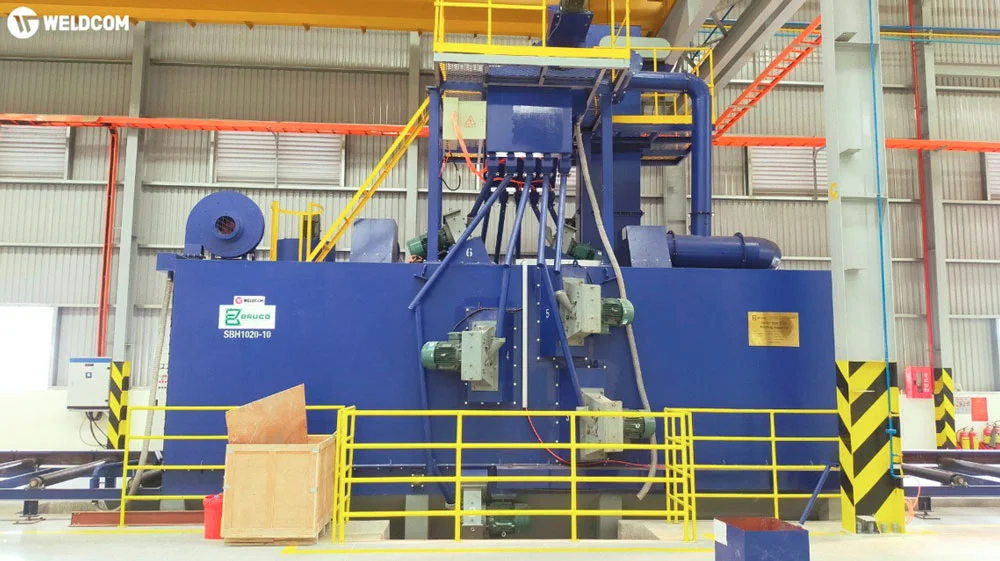
Compact design, flexible, easy to operate and highly efficient The machine has 2 operating modes Auto and Manual, using PLC convenient for workers to operate, with anti-clogging sensor. There are 02 ...
Shot blasting machine is a specialized device used to clean metal surfaces by shooting steel shot or high-speed abrasive material onto the product surface. This process helps remove rust, old paint, scale, welding slag, and impurities, while also creating a uniform roughness to increase adhesion for the next paint or coating layer. The machine has high productivity, good cleaning quality, non-toxic, and low shot consumption. Depending on the production scale, the shot blasting machine can operate in manual, semi-automatic, or automatic modes. A basic system usually includes a shot blasting chamber, shot blasting turbine, shot recovery and classification system, dust filter, and control cabinet, suitable for various applications such as steel structures, mechanical manufacturing, casting, steel plates, steel shapes, and steel beams.
1. What is a shot blasting machine?
Shot blasting machine is a device for treating metal surfaces by shooting steel shot or abrasive material onto the product surface at high speed. This equipment helps remove rust, scale, welding slag, old paint, and creates a uniform roughness before painting, plating, or further processing.
1.1. What is a shot blasting machine used for?
- The shot blasting machine is used to clean metal surfaces before painting, coating, plating, inspection, or assembly. The shot blasting process helps remove unwanted layers such as rust, scale, dirt, welding slag, old paint, and remaining impurities on the steel surface.
- In the steel structure industry, shot blasting machines are commonly used for H beams, I beams, box beams, steel plates, steel shapes, steel columns, steel trusses, and gusset plates. The surface after shot blasting is cleaner and has a more suitable roughness, helping the anti-rust paint or finish paint adhere better than untreated surfaces.
- Besides cleaning, the shot blasting machine also helps standardize surface quality among many products in the same production batch. For factories with stable output, automatic shot blasting machines help reduce manual processing time and limit dependence on the skills of each worker.
Main applications of the shot blasting machine include:
- Cleaning rust on steel surfaces.
- Removing scale, welding slag, old paint, and dirt.
- Creating surface roughness before painting or protective coating.
- Cleaning castings, mechanical parts, steel plates, steel shapes.
- Treating the surface of steel beams, steel structures, steel bridges, lifting equipment.
1.2. Are shot blasting machines and shot cleaning machines the same?
- Shot blasting machines and shot cleaning machines are often used to refer to the same group of metal surface treatment equipment using shot or abrasive particles. Both operate based on the principle of projecting shot onto the product surface to remove rust, scale, old paint, and impurities.
- The term "shot blasting machine" is more popular in the surface treatment, mechanical manufacturing, and steel structure production industries. Meanwhile, "shot cleaning machine" is a more understandable term for newcomers to the equipment, as it directly describes the action of shooting shot to clean the product.
1.3. How is shot blasting different from sandblasting?
- Shot blasting and sandblasting are both methods of cleaning surfaces using abrasive particles, but they differ in blasting material, operating mechanism, particle recovery capability, and level of automation. Industrial shot blasting machines typically use steel shot, steel grit, or metal abrasive materials, while sandblasting often uses technical sand or non-metallic abrasive particles.
- Shot blasting is suitable for industrial production with stable output, especially steel structures, castings, steel plates, steel shapes, and steel beams. Sandblasting is more flexible for large parts, oversized products, or areas that need localized treatment.
| Criteria | Shot blasting machine | Sandblasting |
| Cleaning material | Steel shot, steel grit, metal abrasive | Technical sand or non-metallic abrasive |
| Common mechanism | Centrifugal turbine or compressed air | Mainly uses compressed air |
| Particle recovery capability | High if there is a shot recycling system | Depends on the blasting chamber and recovery system |
| Level of automation | Easily integrated into an automatic machine | Usually flexible, can be manual or semi-automatic |
| Common applications | Steel structures, castings, steel plates, steel shapes | Large structures, diverse details, localized treatment |
| Working environment | Better control if there is a closed chamber and dust filter | Requires more stringent dust and respiratory safety control |
In a steel structure factory, a conveyor shot blasting machine or steel beam shot blasting machine is often suitable when cleaning a large number of H beams, I beams, box beams, or steel shapes is needed. For oversized components, highly variable shapes, or those difficult to pass through automatic machines, a shot blasting chamber may be a more suitable choice.
1.4. What principle does the shot blasting machine use to clean metal surfaces?
- The shot blasting machine cleans metal surfaces by using a turbine to create centrifugal force to accelerate steel shot or abrasive material, then shooting it onto the product surface. The impact force of the shot helps remove rust, scale, old paint, welding slag, and impurities, while also creating uniform roughness before coating.
- The operating principle of the shot blasting machine is based on the centrifugal turbine assembly. Shot is fed into the center of the impeller, then the turbine rotates at high speed to create centrifugal force and project the shot onto the metal surface. The spray angle, turbine speed, number of turbines, and blasting time will directly affect the level of cleanliness, roughness, and cleaning productivity.
- In automatic shot blasting machines, the entire process is usually controlled by a central control cabinet. The operator can set the blasting time, conveyor speed, cleaning cycle, and operation program for each type of product, helping to achieve more consistent surface quality between batches.
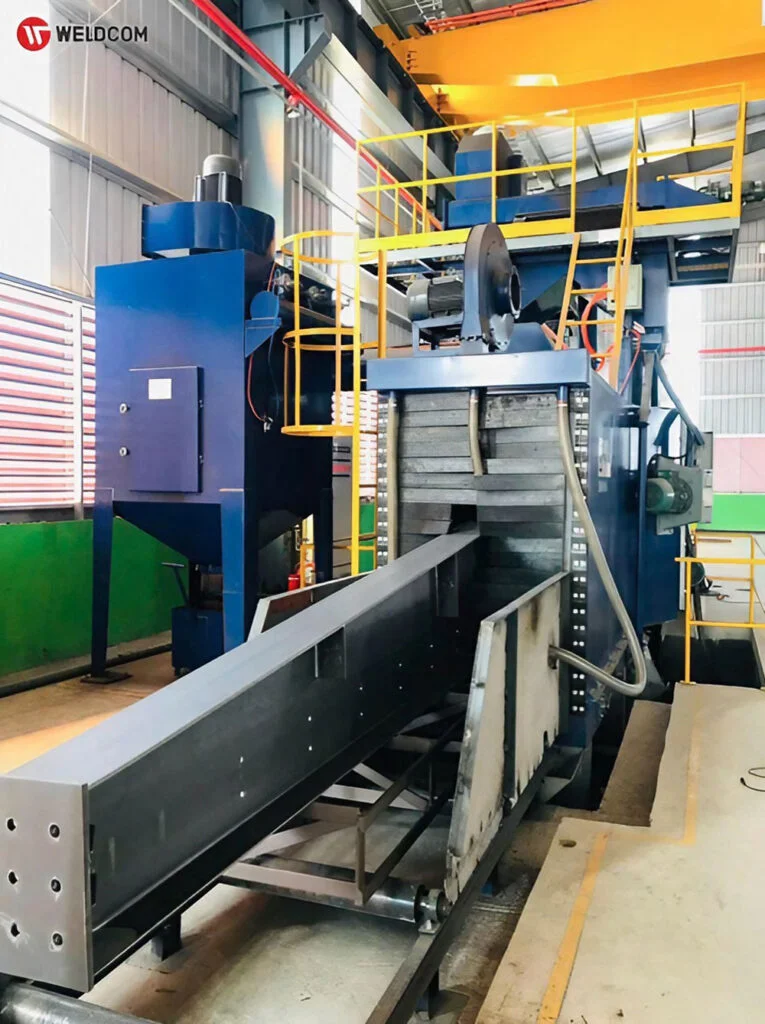
The basic operating process of the shot blasting machine includes 5 steps:
- Step 1: Load the product into the shot blasting chamber
The product is brought into the chamber by hanging hooks, tumbling barrels, roller conveyors, mesh conveyors, or trolleys depending on the machine type. For steel beam shot blasting machines or conveyor shot blasting machines, the workpiece is usually passed through the chamber by a roller or conveyor system.
- Step 2: Turbine rotates at high speed and shoots shot onto the surface
The shot feeding system delivers shot into the turbine, then the turbine uses centrifugal force to project the shot at high speed onto the surface of the part. When the shot impacts the surface, rust, old paint, scale, and dirt are stripped from the metal.
- Step 3: Shot falls into the recovery system after impact
After cleaning the surface, the shot falls to the bottom of the chamber along with dust, broken shot, rust debris, and other impurities. The screw conveyor, belt conveyor, or bucket elevator system will recover this entire mixture to move to the classification stage.
- Step 4: The classification system separates reusable shot and removes dirt
The separator will separate reusable shot from dust, dirt, and broken shot. Shot that meets the requirements will be returned to the shot feeding system to continue the cleaning cycle, while dust and impurities will be transferred to the dust filtration system.
- Step 5: The control cabinet manages the entire process
The entire operating cycle is controlled from the central cabinet. With automatic shot blasting machines, the operator can set time, speed, cleaning mode, and save programs according to each type of product, helping to increase stability in production.
2. Basic structure of the shot blasting machine
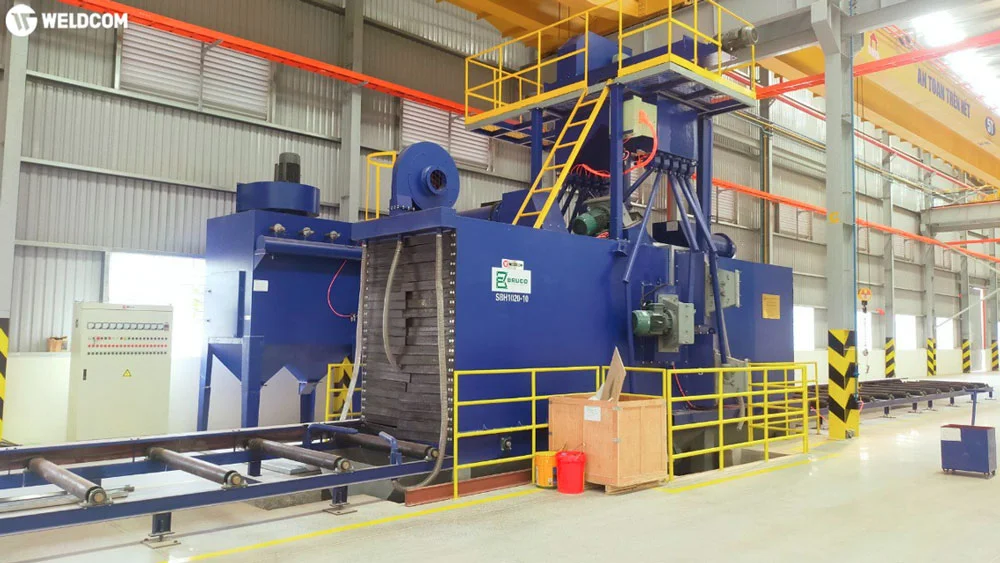
The shot blasting machine usually includes a blasting chamber, shot blasting turbine or blasting gun, shot feeding-recovery-classification system, workpiece transport system, dust filter, control cabinet, and safety mechanisms. The specific structure will vary according to each machine type such as hanging, tumbling barrel, conveyor, steel beam, or shot blasting chamber.
2.1. Shot blasting chamber
- The shot blasting chamber is the area where the shot impacts the workpiece surface. This part is usually designed in a closed or semi-closed form to limit shot from flying out and to help control dust generated during cleaning.
- Inside the chamber, there is usually a wear-resistant lining to protect the machine shell from the continuous impact of the shot. For metal surface cleaning shot blasting machines, the durability of the chamber lining directly affects maintenance costs and long-term operational stability.
- The size of the blasting chamber depends on the type of workpiece to be processed. Tumbling barrel shot blasting machines require a chamber suitable for small details, hanging machines need space for rotating hooks, while conveyor shot blasting machines or steel beam shot blasting machines need a large enough blasting space for steel plates, steel shapes, H beams, I beams, or box beams to pass through.
2.2. Shot blasting turbine or blasting gun
- The shot blasting turbine is the part that creates the force to project the shot using centrifugal blades. This is the most important assembly in many automatic shot blasting machines, as it determines the cleaning speed, surface coverage, and shot consumption rate.
- A turbine assembly usually includes a motor, impeller, centrifugal blades, shot distributor, and spray direction control mechanism. When the turbine operates stably, the shot is projected more evenly, helping the workpiece surface to be cleaned more uniformly.
- The blasting gun usually uses compressed air to project abrasive particles at high speed. This type is commonly found in cleaning shot blasting chambers, suitable for large components, products with complex shapes, or areas that require flexible treatment that automatic machines cannot fully cover.
2.3. Shot feeding, recovery, and classification system
- The shot feeding system is responsible for delivering shot from the storage tank to the turbine or blasting gun. The amount of shot fed needs to be stable to ensure an even spray stream, avoiding uneven cleaning on the workpiece surface.
- After impacting the surface, the shot falls to the bottom of the chamber along with dust, rust scale, broken shot, and impurities. The screw conveyor, bucket elevator, or recovery mechanism will transport this mixture to the classification unit to separate reusable shot from dust and impurities.
- The shot classification unit helps maintain shot quality in the recycling cycle. If the shot is dirty, broken, or contains a lot of dust, it will reduce cleaning efficiency, wear out the equipment faster, and the surface after blasting may not meet the requirements before painting.
2.4. Workpiece transport system
- The workpiece transport system determines the type of product that the shot blasting machine can process. Depending on the configuration, the machine can use hanging hooks, tumbling barrels, mesh conveyors, rubber conveyors, roller conveyors, trolleys, or cranes in the blasting chamber.
- For hanging shot blasting machines, the workpiece is hung on hooks and brought into the chamber. This type is suitable for castings, mechanical parts, welded assemblies, or complex-shaped details that need cleaning on multiple sides.
- For tumbling barrel shot blasting machines, the workpiece is tumbled in a barrel or on a rubber conveyor to expose multiple sides to the shot stream. This type is suitable for small details, small castings, metal accessories, or details that can withstand light impact without deformation.
- For conveyor shot blasting machines or steel beam shot blasting machines, the workpiece moves through the chamber by conveyor or roller. This configuration is commonly used for steel plates, steel shapes, H beams, I beams, box beams, and long steel structure components.
2.5. Dust filter
- The dust filter is responsible for collecting rust dust, paint dust, broken shot, and impurities generated during shot blasting. This part is very important because the metal cleaning process always produces fine dust and dirt particles from the workpiece surface.
- A good dust filtration system helps the blasting chamber be more ventilated, reduces dust spreading to the production area, and protects the mechanical assemblies inside the machine. For cleaning shot blasting chambers, dust filtration is even more important because the operator may work close to or inside the blasting area.
- When choosing a shot blasting machine, do not only focus on turbine power or chamber size and overlook the dust filtration system. If the dust filtration is weak, the machine will easily get dirty, visibility in the blasting chamber will be poor, the working environment will be affected, and surface treatment quality will be difficult to stabilize.
2.6. Control cabinet and safety system
- The control cabinet is used to operate the main assemblies of the machine such as the turbine, conveyor, hanging hooks, tumbling barrel, shot feeding system, shot recovery system, and dust filtration. Depending on the machine type, the control system can be manual, semi-automatic, or automatic.
- With automatic shot blasting machines, the control cabinet helps set the cleaning cycle, conveyor speed, blasting time, and operation sequence. Stable control helps repeat surface quality better between product batches.
- The safety system usually includes emergency stop buttons, blasting chamber door interlocks, error warnings, overload protection, and shot shielding mechanisms. These details help reduce risks during operation, especially with machines with high-power turbines or heavy workpieces.
3. Popular types of shot blasting machines today
Popular types of shot blasting machines today include roller conveyor shot blasting machines, steel beam shot blasting machines, shot blasting chambers, hanging shot blasting machines, tumbling barrel shot blasting machines, and automatic shot blasting machines. Each type is suitable for different workpiece shapes, product sizes, production volumes, and levels of automation.
3.1. Roller conveyor shot blasting machine
- The roller conveyor shot blasting machine is a type of machine that uses a roller system to transport the workpiece through the shot blasting chamber. This equipment is also known as a conveyor shot blasting machine or a conveyor-type shot blasting machine, commonly used for steel plates, steel shapes, steel pipes, H beams, I beams, box beams, and long steel structure components.
- During operation, the workpiece is placed on the roller system and moves through the blasting area at the set speed. The turbines are arranged at different angles so that the shot can reach multiple sides of the product, helping to remove rust, scale, welding slag, and impurities on the metal surface.
- The advantage of the roller conveyor shot blasting machine is its ability to work continuously and easily integrate into the production line. In a steel structure factory, this equipment is usually placed after welding, straightening, inspection, and before coating to ensure the surface of the component meets the requirements before painting.
- The conveyor-type shot blasting machine is suitable for businesses with stable output, long workpieces, or products with repetitive specifications. When choosing a machine, pay attention to the working width, workpiece height, workpiece width, roller load capacity, number of turbines, conveyor speed, and dust filtration system.
3.2. Steel beam shot blasting machine
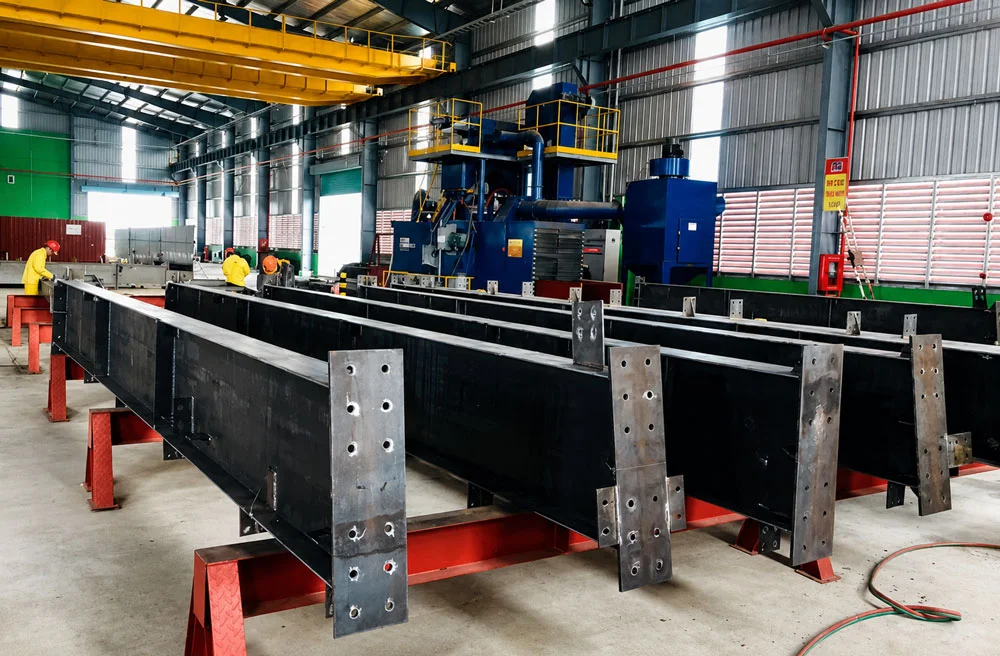
- The steel beam shot blasting machine is a type of machine or configuration specifically used to clean the surface of steel beams, steel shapes, and steel structure components. This equipment usually uses a roller conveyor to transport H beams, I beams, box beams, steel columns, or steel trusses through the blasting chamber.
- In steel structure production, beams after welding and straightening often still have welding slag, scale, rust, or dirt. The steel beam shot blasting machine helps clean the surface and create roughness before anti-rust painting, allowing the paint to adhere better.
- Unlike manual cleaning with a grinder or wire brush, the steel beam shot blasting machine provides more uniform surface quality across many components. The equipment also helps reduce pre-painting processing time, especially for factories producing large quantities of H beams, I beams, box beams, or steel shapes.
- When choosing a steel beam shot blasting machine, businesses need to determine the size of the beams they usually produce. Important parameters include beam height, flange width, beam length, workpiece weight, rust level, required cleanliness level, and desired productivity per shift.
3.3. Shot blasting cleaning chamber
- The shot blasting cleaning chamber is a closed or semi-closed blasting space used to process large details, oversized workpieces, or products with varying sizes. The chamber is usually designed according to the actual size of the product, such as H beams, I beams, steel plates, panels, gusset plates, tanks, or structural frames.
- A basic shot blasting chamber usually includes a blasting area, blasting gun or nozzle system, shot recycling system, dust filter, lighting, and wear-resistant lining. Depending on the investment level, the chamber can operate manually, semi-automatically, or integrate additional workpiece transport support mechanisms.
- The biggest advantage of the shot blasting chamber is its flexibility. For components not suitable for passing through a conveyor shot blasting machine, the chamber allows operators to process various types of products without being too dependent on the machine door size or conveyor width.
- The shot blasting chamber is suitable for medium-sized steel structure workshops, diverse products, or frequently processing large workpieces. When investing in a chamber, consider the workshop area, crane path, shot recovery system, dust filtration capacity, lighting, ventilation, and operator safety.
3.4. Hanging shot blasting machine
- The hanging shot blasting machine is a type of machine that uses hanging hooks, hanging racks, or rotating hanging assemblies to bring the product into the blasting chamber. During cleaning, the workpiece is hung on hooks and can rotate to allow the shot to reach multiple sides of the detail.
- This type of machine is suitable for castings, welded assemblies, mechanical parts, structural accessories, or products with complex shapes. Compared to tumbling barrel shot blasting machines, hanging machines help limit impact between details, suitable for products that should not be tumbled or are easily dented when impacted.
- The advantage of the hanging shot blasting machine is its flexibility with various detail shapes. Some configurations can use single hooks, double hooks, or hanging rail systems to increase the ability to load and unload workpieces.
- However, the hanging shot blasting machine is not the optimal choice for long steel plates, long beams, or large bar-shaped components. For this product group, roller conveyor shot blasting machines or shot blasting chambers are usually more suitable in terms of productivity and operation handling.
3.5. Tumbling barrel shot blasting machine
- The tumbling barrel shot blasting machine is a type of machine that uses a rotating barrel or tumbling rubber conveyor to clean batches of small details. During blasting, the details are tumbled evenly to expose multiple sides to the shot stream, helping to remove rust, oxide layers, casting sand, burrs, or impurities on the surface.
- This type of machine is suitable for small castings, forged parts, bolts, nuts, rivets, metal accessories, and small details. Tumbling barrel shot blasting machines are commonly used in foundries, auxiliary mechanical workshops, component manufacturing plants, or steel structure accessory workshops.
- The advantage of the tumbling barrel shot blasting machine is its compact design, relatively simple operation, and effectiveness with small batch-produced products. The equipment helps clean multiple details at once, reducing manual processing time and saving space compared to large-sized shot blasting systems.
- The limitation of the tumbling barrel shot blasting machine is that it is not suitable for long, heavy, large-sized details or products that are easily deformed by impact. For details requiring a scratch-free surface or should not be strongly impacted, businesses should consider hanging shot blasting machines or more suitable blasting solutions.
3.6. Automatic shot blasting machine
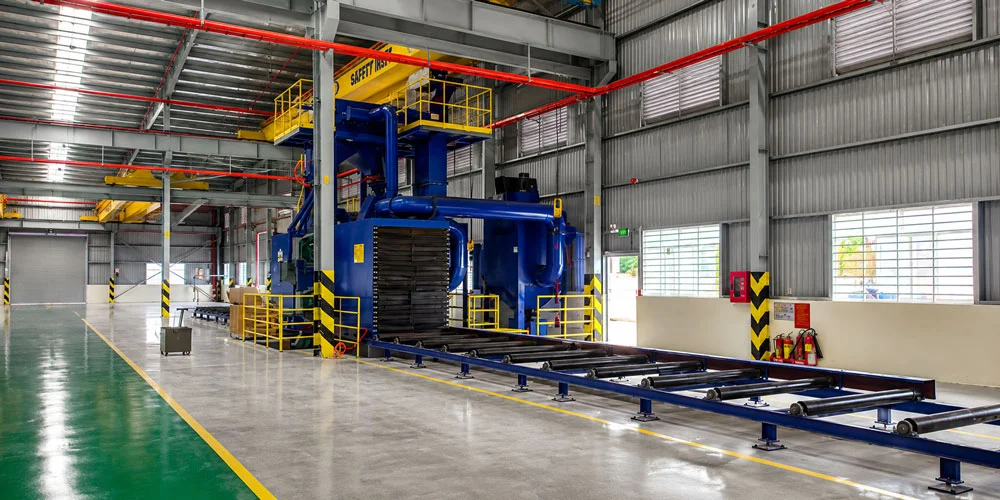
- The automatic shot blasting machine is a group of machines with partially or fully automated operation cycles, from workpiece feeding, shot blasting, shot recovery, shot classification, to dust filtration and cleaning time control. Automatic machines can be roller conveyor type, hanging type, tumbling barrel type, or specialized production lines.
- In modern systems, automatic shot blasting machines can integrate PLC, state sensors, error warnings, conveyor speed control, blasting time, and cleaning mode according to each product group. These features help the operation process be more stable and reduce dependence on manual handling.
- Automatic shot blasting machines are suitable for factories with large output, repetitive products, and require uniform surface quality. In the steel structure industry, the automatic type is often prioritized when businesses need to continuously process steel beams, steel plates, steel shapes, or components before painting.
- It should be noted that "automatic shot blasting machine" is not a single structural type. This is a term based on the level of automation of the equipment, so when choosing, it is necessary to clearly determine whether the automatic machine is a conveyor type, hanging type, tumbling barrel type, blasting chamber, or specialized system according to the production line.
3.7. Comparison table of popular shot blasting machine types
| Type of shot blasting machine | Suitable workpiece | Main advantages | Limitations to note |
| Roller conveyor shot blasting machine | Steel plates, steel shapes, H beams, I beams, box beams | Continuous operation, easy line integration | Requires long space and suitable machine width |
| Steel beam shot blasting machine | Steel beams, steel shapes, KCT components | Suitable for steel structure factories | Need to choose according to beam size and load capacity |
| Shot blasting cleaning chamber | Large structures, oversized workpieces, diverse products | Flexible, can handle many types of workpieces | More dependent on operation handling |
| Hanging shot blasting machine | Castings, welded assemblies, complex mechanical parts | Limits impact between details | Not optimal for long workpieces, large bar-shaped components |
| Tumbling barrel shot blasting machine | Small details, bolts, accessories, small castings | Batch cleaning, space-saving | Not suitable for large or easily deformed details |
| Automatic shot blasting machine | Repetitive products, high output | Stable quality, reduces manual handling | Requires systematic investment, maintenance, and operation |
4. In which industries are shot blasting machines used?
Shot blasting machines are used in industries that require cleaning metal surfaces before painting, coating, or processing, such as steel structures, casting, mechanical manufacturing, shipbuilding, steel bridges, and steel plate production. The equipment helps remove rust, scale, welding slag, and creates a more stable surface roughness.
4.1. Steel structure and pre-engineered steel building industry
- In steel structures, shot blasting machines are used to clean H beams, I beams, box beams, steel columns, steel trusses, gusset plates, and welded assemblies. The equipment helps remove welding slag, scale, rust, and dirt before anti-rust painting.
- For factories with stable output, steel beam shot blasting machines or roller conveyor shot blasting machines are often more suitable than manual cleaning. The machines are usually placed after welding, straightening, inspection, and before coating.
4.2. Casting and forging industry
- In the casting industry, shot blasting machines are used to clean casting sand, oxide layers, small burrs, and impurities on the surface of castings. This stage helps the details be cleaner before mechanical processing, painting, or quality inspection.
- For small details like bolts, metal accessories, or small castings, tumbling barrel shot blasting machines are often used. For large castings or complex details, hanging shot blasting machines are more suitable because they limit impact between products.
4.3. Mechanical manufacturing industry
- In mechanical manufacturing, shot blasting machines for cleaning metal surfaces are used for machine frames, machine shells, machine bases, welded assemblies, and machined parts. The machines help remove light rust, welding slag, oxide layers, or old paint before finishing.
- Depending on the product size, mechanical workshops can use hanging shot blasting machines, tumbling barrel shot blasting machines, conveyor shot blasting machines, or shot blasting chambers. If the product changes a lot in size, shot blasting chambers are usually more flexible.
4.4. Shipbuilding and large steel construction industry
- In shipbuilding and large steel construction, shot blasting machines are used to process steel plates, steel shapes, steel modules, and large structures before anti-corrosion painting. This is an important stage because marine, outdoor, or industrial environments easily corrode metal.
- For mass-produced steel plates and steel shapes, conveyor shot blasting machines help clean continuously. For ship blocks, tanks, or oversized components, shot blasting cleaning chambers are usually more suitable.
4.5. Steel bridges, infrastructure, and lifting equipment
- In steel bridges, infrastructure, and lifting equipment, shot blasting machines are used for bridge beams, box beams, lifting frames, machine bases, and large load-bearing components. The goal is to create a clean surface with suitable roughness before protective coating.
- For H beams, I beams, box beams, or long steel shapes, steel beam shot blasting machines help process the surface more uniformly than manual cleaning. If the component is too large or has a complex shape, a shot blasting chamber is a more flexible choice.
4.6. Steel plate, steel shape production, and metal processing
- Shot blasting machines are also used in the production of steel plates, steel shapes, steel pipes, and semi-finished metal parts. The equipment helps clean the surface before cutting, welding, painting, plating, or further processing.
- For large quantities of steel plates and steel shapes, conveyor shot blasting machines are a suitable choice because they can process continuously. The roller system transports the workpiece through the chamber, helping to increase productivity and standardize surface quality.
5. Why is a shot blasting machine needed to clean metal surfaces before painting?
Shot blasting machines clean metal surfaces before painting by removing rust, scale, welding slag, dirt, and old paint remaining on the surface. This process also creates suitable roughness, helping the anti-rust paint or coating adhere more firmly and stably.
5.1. Remove rust, scale, and impurities
- Metal surfaces after rolling, welding, storage, or transportation often have rust, scale, dirt, grease, or welding slag. If painted directly on untreated surfaces, the paint layer is prone to poor adhesion, peeling, or defects after a period of use.
- Shot blasting machines help strip these adhering layers by the impact force of steel shot or abrasive material. Compared to manual cleaning, shot blasting provides a more uniform surface, especially for steel plates, steel shapes, steel beams, and large steel structure components.
5.2. Create surface roughness before painting
- In addition to cleaning, shot blasting machines also create roughness on metal surfaces. This roughness helps the primer, anti-rust paint, or protective coating have better adhesion points on the steel surface.
- The roughness after shot blasting depends on the type of shot, shot size, blasting speed, blasting time, and blasting distance. Therefore, when choosing a shot blasting machine for cleaning metal surfaces, businesses need to clearly determine the coating requirements to select the appropriate configuration.
5.3. What are Sa2.5 and Sa3 cleaning levels?
- Sa2.5 and Sa3 are metal surface cleaning levels commonly used in surface treatment before painting. Sa2.5 is usually understood as near-white cleaning, with very few remaining stains, rust, or tightly adhering scale; Sa3 is white metal cleaning with higher requirements.
- In industries such as steel structures, steel bridges, shipbuilding, or outdoor construction, Sa2.5 requirements are often encountered before anti-corrosion painting. Shot blasting machines can help achieve this cleaning level if the correct shot type, turbine power, conveyor speed, blasting time, and surface inspection process are chosen.
5.4. Increase the durability of the coating
- The protective coating only works effectively when the substrate surface is clean enough and has suitable roughness. If the surface still has rust, dust, oil, or scale, the paint layer may peel, blister, or rust again from the inside.
- For steel structures, steel beams, steel bridges, or equipment working outdoors, surface treatment before painting directly affects the coating's lifespan. Proper shot blasting helps the paint layer adhere more stably, reducing corrosion risk and repair costs during use.
5.5. Reduce painting errors and repair costs
- Painting errors often occur when the metal surface is not cleaned properly or the roughness is not suitable. Common errors include paint peeling, surface pitting, blistering, early rusting, or uneven paint layers.
- Investing in automatic shot blasting machines or shot blasting cleaning chambers helps control surface quality better before painting. The cost of proper surface treatment from the start is often much lower than the cost of fixing painting errors, repainting, or maintaining structures after being put into use.
6. How to choose a suitable shot blasting machine
To choose a suitable shot blasting machine, businesses need to determine the type of workpiece to be cleaned, product size and weight, production volume, required cleanliness level, workshop space, level of automation, and post-shot blasting process. Choosing the right machine helps optimize productivity, surface quality, and operating costs.
6.1. Choose according to the type of workpiece to be cleaned
The type of workpiece is the first factor to determine when choosing a shot blasting machine. Each type of product has different geometry, size, and processing methods, so one type of machine cannot be used for all needs. Basic selection can be referenced as follows:
| Type of workpiece | Suitable equipment |
| Small details, bolts, metal accessories | Tumbling barrel shot blasting machine |
| Castings, welded assemblies, complex mechanical parts | Hanging shot blasting machine |
| Steel plates, steel shapes, steel pipes | Roller conveyor shot blasting machine |
| H beams, I beams, box beams, KCT components | Steel beam shot blasting machine |
For steel structure factories, the group of equipment that should be prioritized is usually conveyor shot blasting machines, steel beam shot blasting machines, or shot blasting cleaning chambers. These are more suitable choices for steel beams, steel shapes, gusset plates, and large-sized components.
6.2. Choose according to workpiece size and weight
The workpiece size determines the chamber width, machine door height, working width, and product transport method. If the machine's working width is too small, large workpieces cannot pass through or must be processed with additional manual methods. The information to determine includes:
- Maximum workpiece length.
- Maximum workpiece width.
- Maximum workpiece height.
- Workpiece weight.
- Workpiece shape.
- Whether the product is easily impacted, warped, or deformed.
For steel beam shot blasting machines, pay special attention to beam height, flange width, beam length, and roller load capacity. For shot blasting chambers, also consider handling space, crane path, workpiece feeding area, and workpiece retrieval area after cleaning.
6.3. Choose according to production volume
Production volume directly affects the level of automation to invest in. If the volume is low and the product changes continuously, chambers or semi-automatic machines may be more flexible. If the volume is large, automatic machines will help save time and stabilize surface quality better.
| Production volume | Suggested equipment |
| Low, diverse products | Flexible shot blasting chamber or hanging machine |
| Medium | Hanging machine, tumbling barrel, or semi-automatic conveyor |
| High, repetitive products | Automatic shot blasting machine |
| Very high, long workpieces, or continuous production | Integrated conveyor/roller shot blasting machine |
Businesses should not choose machines based solely on the highest capacity. The suitable configuration should be based on actual production volume, working hours per shift, painting process productivity, and workpiece feeding capability in the workshop.
6.4. Choose according to cleanliness level and surface requirements
Each industry has different surface treatment requirements. Common steel structures, steel bridges, shipbuilding, oil and gas, or export equipment may require different cleanliness levels and roughness before coating. When choosing a shot blasting machine, businesses need to determine:
- What cleanliness level the surface needs to achieve.
- Whether there are Sa2.5, Sa3, or specific standards required.
- Desired surface roughness.
- Type of paint or coating used after shot blasting.
- Rust level, scale, or old paint on the input workpiece.
If high surface requirements are needed, pay attention to turbine power, shot type, conveyor speed, blasting time, number of turbines, and dust control capability. The machine must create a uniform surface, not just clean part of the product.
6.5. Choose according to the level of automation
- Shot blasting machines can operate manually, semi-automatically, or automatically depending on production needs. The higher the level of automation, the better the control of the blasting cycle, shot recovery, dust filtration, and workpiece transport, but the investment cost and maintenance requirements are also higher.
- For small workshops or unstable products, shot blasting chambers or semi-automatic machines may be more suitable. For steel structure factories, casting, steel shapes, or mass production, automatic shot blasting machines help reduce dependence on manual handling and increase uniformity between product batches.
- When choosing automatic machines, check the ability to set conveyor speed, blasting time, cleaning cycle, error warnings, state sensors, and integration capability with existing production lines.
6.6. Choose according to workshop space and production process
- The workshop space determines the layout of the shot blasting machine, workpiece feeding direction, workpiece exit direction, dust filtration position, maintenance area, and connection with the coating stage. If not properly arranged, the shot blasting machine can become a bottleneck even if the equipment capacity is large enough.
- For conveyor shot blasting machines, a long space is needed in the direction of workpiece movement. For shot blasting chambers, space is needed for components, operators, cranes, shot recovery systems, dust extraction systems, and safety areas.
- In steel structure production lines, shot blasting machines should usually be placed after welding, straightening, inspection, and before painting. This layout helps the component surface be cleaned at the right time, limits re-rusting, and reduces unnecessary transport handling.
6.7. Choose according to operating and maintenance costs
- Besides the initial purchase price, businesses need to calculate the long-term operating costs of the shot blasting machine. Common costs include shot consumption, electricity, abrasive materials, dust filter cartridges, turbine maintenance, chamber lining replacement, and operator labor.
- Parts such as turbine blades, chamber lining, screw conveyors, bucket elevators, and dust filters need to be checked periodically. If choosing a low-priced machine but with poor shot recovery, dust filtration, or wear-resistant materials, maintenance costs may increase significantly later.
- When comparing different shot blasting machine models, evaluate the total cost of ownership instead of just looking at the initial investment price. A suitable device must balance productivity, surface quality, stability, material costs, and maintenance capability under actual production conditions.
7. Notes on operating and maintaining shot blasting machines
Operating shot blasting machines requires controlling the type of shot, turbine condition, shot recovery system, dust filter, and workpiece processing speed. Proper maintenance helps the machine clean stably, reduce shot consumption, limit dust spreading, and avoid unplanned machine downtime.
7.1. Choose the right type of shot
- The type of shot directly affects the cleaning speed, surface roughness, and material consumption costs. For steel plates, steel shapes, steel beams, or steel structures, businesses usually use steel shot or steel grit suitable for cleaning requirements before painting.
- Shot size should be chosen according to the surface condition and post-blasting requirements. Larger shot creates stronger impact force, while smaller shot provides a smoother surface but may require longer processing time.
7.2. Check the turbine and centrifugal blades
- The turbine is the main blasting force assembly of many automatic shot blasting machines. Parts such as centrifugal blades, impellers, shot distributors, and direction control boxes are often worn during operation.
- When the centrifugal blades wear out, the shot stream may be weak, misaligned, or unevenly distributed. This condition reduces cleaning efficiency, increases blasting time, and makes the surface after processing difficult to meet pre-painting requirements.
7.3. Maintain the shot recovery and classification system
- The shot recovery and classification system helps return the shot after blasting to the usage cycle. If the screw conveyor, bucket elevator, or separator operates unstably, shot can be lost, jammed, or mixed with a lot of dirt.
- The separator needs to separate reusable shot from dust, broken shot, rust debris, and impurities. Clean shot helps the turbine work more stably and maintain metal surface cleaning quality.
7.4. Check the dust filter
- The dust filter helps collect rust dust, paint dust, broken shot, and impurities generated during shot blasting. If the dust filter is weak or clogged, the blasting chamber can become foggy, the working environment is affected, and the machine gets dirty quickly.
- For cleaning shot blasting chambers, the dust extraction system is even more important because the operator may work closer to the blasting area. Businesses should check filter cores, filter bags, or filter cartridges periodically.
7.5. Control conveyor speed and blasting time
- For conveyor shot blasting machines or steel beam shot blasting machines, the roller speed directly affects the time the workpiece stays in the blasting area. If the speed is too fast, the surface may not be evenly cleaned; if too slow, productivity decreases, and operating costs increase.
- Blasting time should be set according to rust level, material type, shot type, and post-processing surface requirements. For repetitive products, suitable parameters should be saved to stabilize quality between batches.
7.6. Check the wear-resistant lining
- The shot blasting chamber continuously withstands high-speed shot impact, so the wear-resistant lining needs to be checked regularly. If the lining wears deeply, the chamber shell may be punctured, causing shot leakage, dust spreading, and safety hazards.
- Positions directly exposed to the shot stream usually wear out faster. When the lining plate is found to be cracked, peeling, or heavily worn, it should be replaced early to prevent widespread damage.
8. What factors affect the price of shot blasting machines?
The price of shot blasting machines depends on the machine type, chamber size, working width, number of turbines, shot recovery system, dust filter, level of automation, and production line integration requirements. Since each factory has different workpiece types and production volumes, pricing needs to be based on actual configuration.
8.1. Type of shot blasting machine
- Each type of shot blasting machine has different structures and investment levels. Tumbling barrel shot blasting machines are usually used for small details, hanging shot blasting machines are suitable for castings or welded assemblies, while conveyor shot blasting machines are suitable for steel plates, steel shapes, and steel beams.
- Shot blasting chambers have prices that depend heavily on chamber size, number of blasting guns, shot recovery system, dust filtration, lighting, and ventilation. Therefore, the correct workpiece type should be determined before comparing prices.
8.2. Workpiece size and working width
- The larger the workpiece, the larger the chamber, machine door, conveyor, rollers, and load-bearing structure need to be designed. For steel beam shot blasting machines, determine beam height, flange width, beam length, and maximum weight.
- If the machine is too small, the factory will be limited when receiving larger orders. If the machine is too large compared to the need, investment costs, electricity consumption, and floor space will increase unnecessarily.
8.3. Number of turbines and cleaning capacity
- The number of turbines affects the coverage area, cleaning speed, and machine productivity. Machines with more turbines can clean multiple sides better, especially with steel shapes, H beams, I beams, or components with many edges.
- However, turbines should not be chosen based on the criterion of more being better. The suitable configuration should be based on the workpiece type, rust level, required cleanliness level, conveyor speed, and actual production volume.
8.4. Shot recovery and dust filtration system
- The shot recovery system helps reduce material loss and maintain cleaning efficiency. The dust filter helps control generated dust, protect the working environment, and reduce dirt buildup in the machine.
- These are two items that should not be excessively cut when investing. Good shot recovery and dust filtration will directly affect operating costs, equipment stability, and post-blasting surface quality.
8.5. Level of automation
- Shot blasting machines can operate manually, semi-automatically, or automatically. The higher the level of automation, the more complex the control system, sensors, transport mechanisms, and program setting capabilities.
- Automatic shot blasting machines are suitable for factories with large output, repetitive products, and require uniform surface quality. For diverse product workshops, shot blasting chambers or semi-automatic machines may be more flexible.
8.6. Production line integration requirements
- If the shot blasting machine needs to be integrated into a steel structure production line, the cost will depend on conveyors, rollers, workpiece feeding direction, waiting area, interlocking control system, and connection with the coating stage.
- In KCT production lines, shot blasting machines often need to be synchronized with welding, straightening, inspection, and painting. If the shot blasting capacity is lower than other stages, the equipment can become a bottleneck in the entire process.
8.7. Should you choose cheap shot blasting machines?
- Do not choose shot blasting machines based solely on low prices, as long-term operating costs can be greater than the initial savings. Machines with poor turbines, linings, dust filters, or shot recovery systems can cause shot waste, excessive dust, unstable surface quality, and frequent maintenance issues.
- When comparing quotes, businesses should evaluate the total cost of ownership, including machine price, consumables, electricity, maintenance, spare parts, and after-sales technical services.
9. Where is the shot blasting machine located in the steel structure production line?
In the steel structure production line, the shot blasting machine is usually placed after welding, straightening, inspection, and before coating. This position helps steel components be cleaned of rust, scale, welding slag, and create suitable roughness before anti-rust or finish painting.
9.1. After welding and straightening
- After welding, the component surface often still has welding slag, spatter, scale, dirt, or light rust. If the component is painted immediately, the paint layer may have poor adhesion and easily develop defects during use.
- Therefore, the shot blasting machine is usually placed after welding and straightening. When the component has reached the required shape, shot blasting will help clean the surface before moving to coating.
9.2. Before anti-rust or finish painting
- The shot blasting machine is usually the surface preparation stage right before painting. The surface after shot blasting is cleaner, has more suitable roughness, and supports the anti-rust paint layer to adhere more firmly to the metal substrate.
- After shot blasting, the component should not be left too long in a humid or dusty environment. If the waiting time is too long, the steel surface may re-rust and reduce the effectiveness of the surface treatment stage.
9.3. In the production line of H beams, I beams, and box beams
For H beams, I beams, box beams, or long steel shapes, steel beam shot blasting machines usually use roller conveyors to transport the workpiece through the blasting chamber. This configuration is suitable for steel structure factories with stable output and needs to process many components before painting. In the steel beam production line, the process flow can be:
- Cutting steel plate workpieces.
- Tacking and welding beams.
- Straightening after welding.
- Checking dimensions and welds.
- Shot blasting surface cleaning.
- Anti-rust or finish painting.
9.4. Table of shot blasting machine positions in the KCT production line
| Stage | Commonly used equipment | Main role |
| Cutting | CNC cutting machine, plasma cutting machine, laser cutting machine | Create details according to drawings |
| Tacking/welding | Tacking machine, welding machine, welding robot | Create steel components |
| Straightening/adjusting | Beam straightening machine, shaping equipment | Bring components to the correct tolerance |
| Inspection | Measuring tools, visual inspection, NDT if needed | Evaluate quality before finishing |
| Cleaning | Shot blasting machine, shot blasting chamber | Clean and create surface roughness |
| Coating | Painting booth, painting equipment | Protect against corrosion and finish the product |
10. How does Weldcom advise on shot blasting machines and surface cleaning solutions?
Weldcom advises on shot blasting machines according to the type of workpiece, product size, production volume, required cleanliness level, workshop space, and production process of each business. For the steel structure industry, the solution may include steel beam shot blasting machines, conveyor shot blasting machines, shot blasting chambers, or integrated automatic systems before the coating stage.
10.1. Advice according to the type of product to be cleaned
- Each product group requires a different shot blasting machine configuration. Small details may be suitable for tumbling barrel shot blasting machines, castings or welded assemblies may be suitable for hanging shot blasting machines, while steel beams and steel shapes usually require roller conveyor shot blasting machines.
- For large components, oversized workpieces, or products with varying sizes, shot blasting cleaning chambers may be a more flexible solution. The equipment selection should be based on actual workpieces, not just the machine name.
10.2. Advice according to the steel structure production line
- For steel structure factories, shot blasting machines should not be considered standalone equipment. The equipment needs to be placed within the overall production line, including cutting, welding, straightening, inspection, shot blasting, and coating.
- If the shot blasting machine capacity is lower than the welding or coating stage, the cleaning area can become a bottleneck. Weldcom can advise on configurations according to actual production flow to reduce waiting time, optimize space, and increase operational efficiency.
10.3. Advice according to workshop space, dust filtration, and operational safety
- Shot blasting machines require space for the blasting chamber, workpiece feeding area, workpiece retrieval area, shot recovery system, dust filter, and maintenance path. For conveyor shot blasting machines, the length should be calculated according to the workpiece movement direction; for shot blasting chambers, also consider the crane or forklift path.
- The dust filtration and shot recovery system also need to be calculated correctly from the start. Suitable dust filtration helps create a cleaner working environment, while good shot recovery helps reduce material loss and stabilize cleaning efficiency.
10.4. Information needed when contacting Weldcom
To be advised on a suitable configuration, businesses should prepare the following basic information:
- Type of workpiece to be cleaned.
- Maximum and common workpiece sizes.
- Workpiece weight.
- Workpiece material.
- Production volume per day, month, or shift.
- Rust level, scale, welding slag, or old paint.
- Required cleanliness level and roughness if any.
- Post-shot blasting process: painting, plating, processing, or assembly.
- Workshop space and existing transport equipment.
- Desired level of automation and budget.
10.5. Solution orientation for KCT factories
- For steel structure factories, Weldcom can advise on shot blasting machines as part of a complete production line solution. Depending on the need, the configuration can be combined with H beam production lines, box beams, welding robots, beam straightening machines, turnover stations, and coating areas.
- The solution-oriented approach helps businesses not only choose the right shot blasting machine but also better control the entire process from processing, welding, cleaning to finish coating. This is a suitable direction for workshops that want to increase productivity, reduce surface errors, and standardize product quality before delivery.
11. Frequently asked questions about shot blasting machines
11.1. Are shot blasting machines and shot cleaning machines different?
Shot blasting machines and shot cleaning machines are often two terms for the same group of metal surface treatment equipment. "Shot blasting machine" is a more popular term in the industry, while "shot cleaning machine" is a term that directly describes the action of shooting shot onto the surface.
11.2. Can shot blasting machines achieve Sa2.5?
Shot blasting machines can help achieve Sa2.5 cleanliness level if the correct machine configuration, shot type, turbine power, conveyor speed, and blasting time are chosen. The actual result also depends on the input surface condition, rust level, operating process, and inspection standards of each project.
11.3. Are conveyor shot blasting machines suitable for H beams, I beams, and box beams?
- Yes. Conveyor shot blasting machines or roller conveyor shot blasting machines are suitable for cleaning H beams, I beams, box beams, steel shapes, and long steel structure components.
- The equipment transports the workpiece through the blasting chamber using a roller system, helping to process the surface continuously before the coating stage.
If businesses need advice on shot blasting machines or metal surface cleaning solutions for steel structure production lines, please contact Weldcom via hotline 1900 9410 or website weldcom.vn for support in choosing a configuration suitable for the product, production volume, and investment budget. We look forward to welcoming you!