
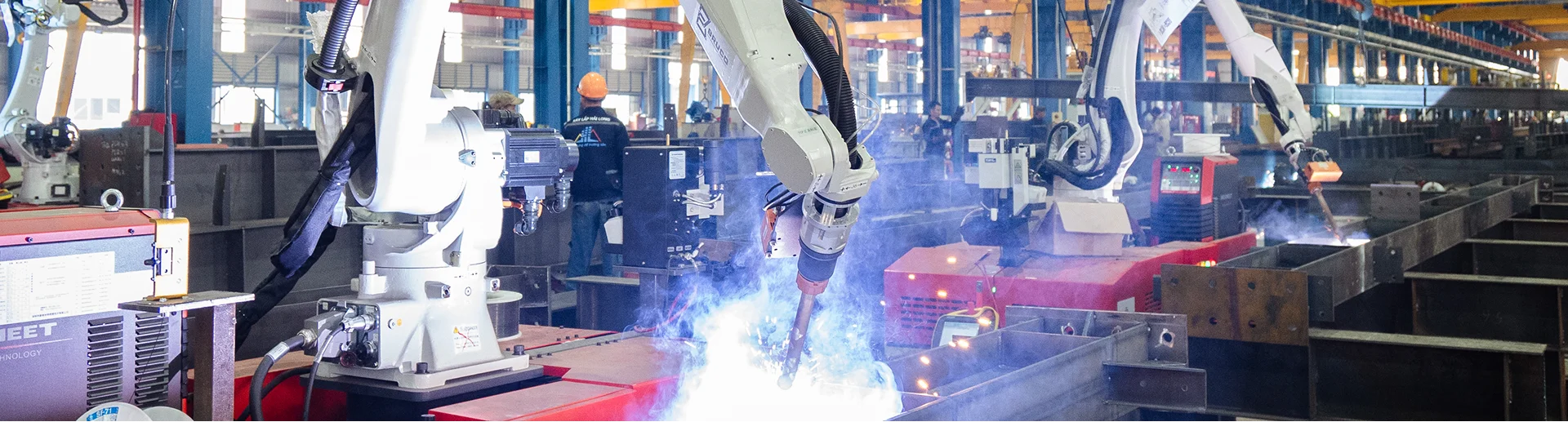
Robotic Welding Solutions
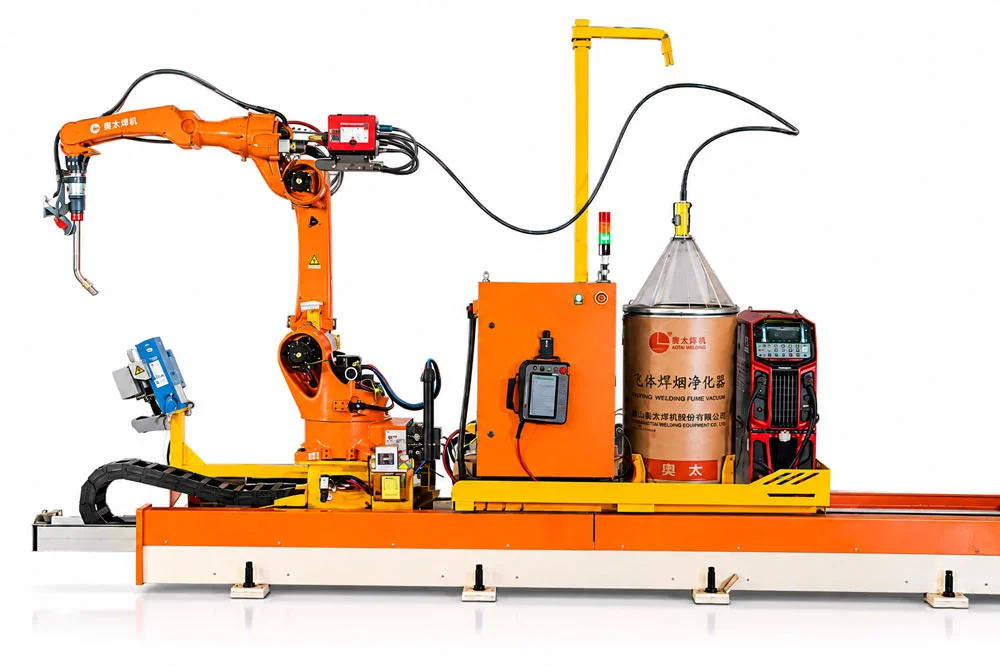
3D Camera & smart image processing : Automatically scan real products and create welding programs, independent of drawings. Extended rail system (optional) : Increase the reach and working space ...
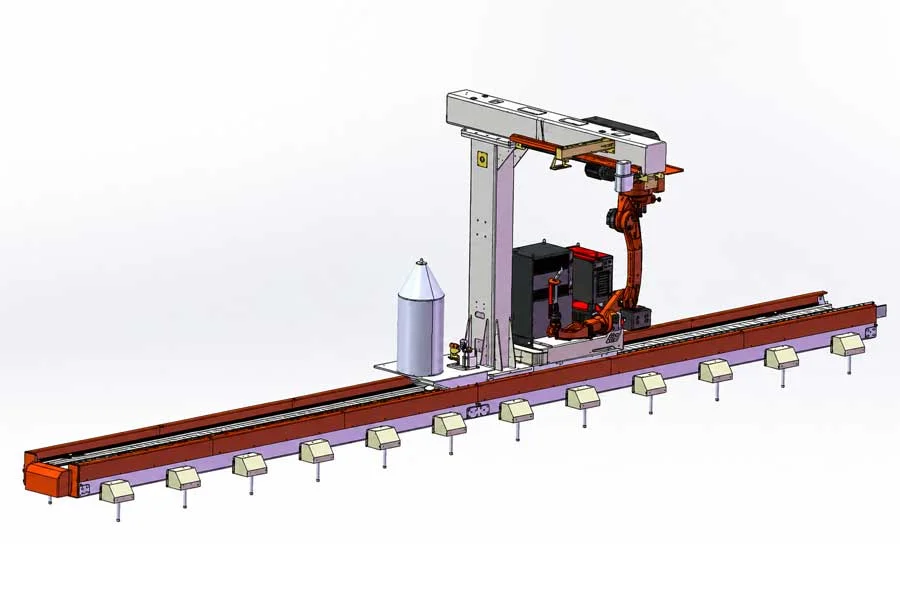
Suitable for beams, panels, and large components in the steel structure and shipbuilding industry. No manual programming required Flexible with various types of products, small batches, and custom ...
Welding robots are one of the automated solutions for mechanical factories that many businesses are interested in, helping to replace manual labor with precise, fast, and stable welding machinery lines.
The following content will help you better understand what welding robots are, their structure, operation, classification, as well as information on prices and notes that businesses need to consider when planning to invest in this machinery line.
1. Overview of welding robots
1.1. What is a welding robot?
A welding robot is a type of industrial robot programmed specifically to handle the welding process in production.
Instead of a welder performing manual welding, the robot uses a robotic arm to bring the welding torch to the required welding position, with the angle and speed of welding executed according to the programmed parameters, ensuring precise welds and stable productivity.
1.2. Structure of a welding robot
A welding robot operates thanks to the combination of a robotic arm, welding source, welding torch, wire feeder, torch cleaning station, and robot base. Specifically:
- Robotic arm is responsible for movement, bringing the welding torch to the correct welding position according to the programmed schedule.
- Welding torch or welding gun is the component that directly creates the weld on the part.
- Welding source is the component responsible for supplying electricity and the appropriate welding mode to create the weld.
- Wire feeder functions to deliver the welding wire to the welding torch at a stable speed throughout the robot's welding process.
- Torch cleaning station helps the robot remove spatter, cut wire, and maintain a stable welding head condition throughout the process.
- Robot base holds the robot in place, ensuring stability and accuracy when the robot operates.
1.3. Operating principle of welding robots
With intelligent welding robot solutions, the production process will be fully automated with the following steps:
Scan the workpiece to create a 3D model > Set up the welding path > Proceed with automatic welding cycles.
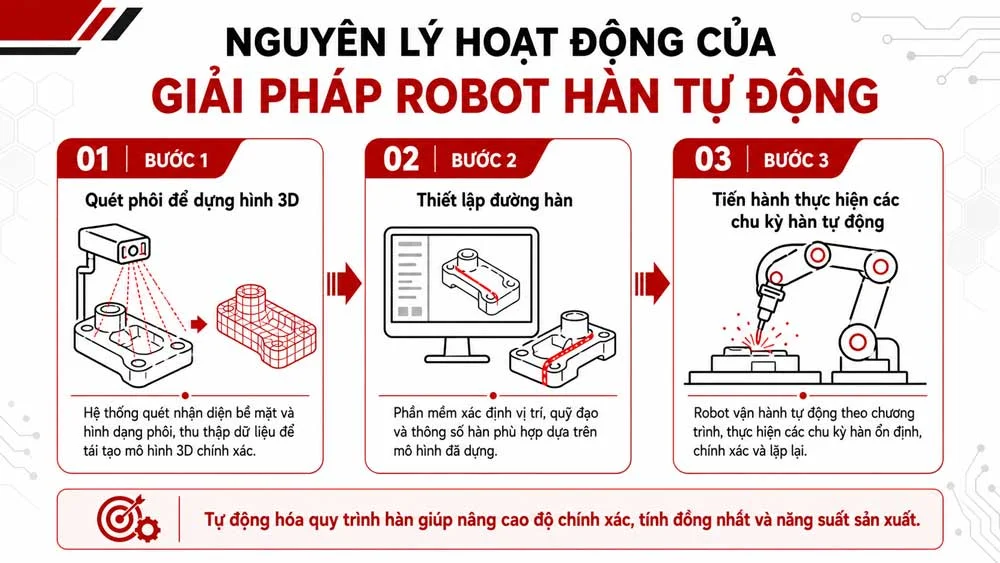
An automatic welding cycle of an industrial robot will proceed as follows:
Step 1: Workers perform the setup and clamping of the workpiece into the jig. The system will check and confirm whether the workpiece is in the correct position and whether safety conditions are met before operation.
Step 2: The welding robot automatically follows the pre-programmed schedule to move the welding torch to the starting point for welding.
Step 3: Supply protective gas before the welding robot starts the arc to protect the welding area from oxidation.
Step 4: The welding source is activated, the wire feeder operates, and the robot begins welding.
Step 5: After completing the weld, the robot turns off the arc and maintains protective gas for a short time if needed.
Step 6: The welding robot moves to the next weld or returns to the waiting position for a new welding cycle.
Step 7: When a welding cycle ends, the workpiece is removed, inspected, and moved to the next stage.
2. Advantages of industrial welding robots
Investing in an industrial welding robot automation line brings many benefits to businesses in terms of productivity and quality, costs, and personnel:
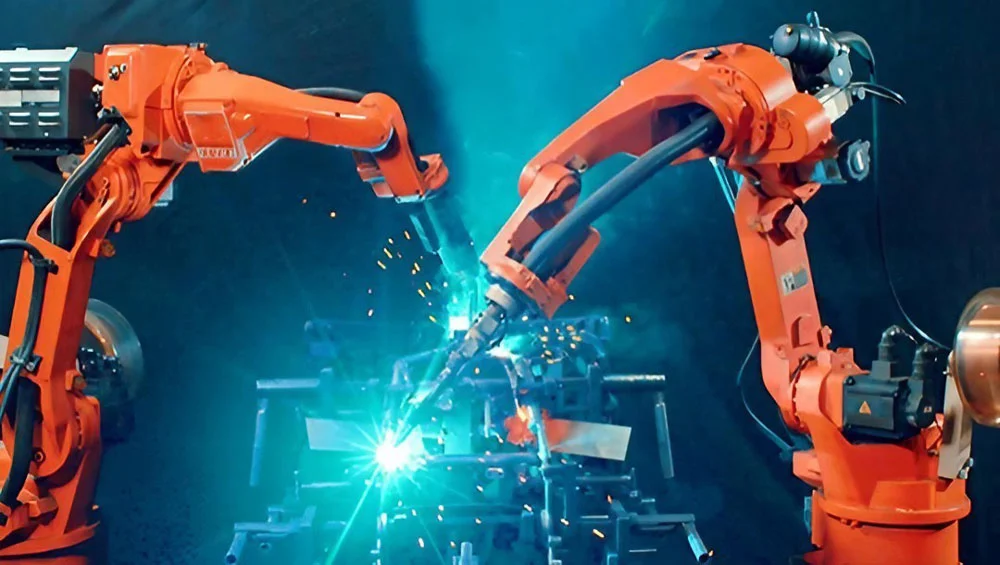
Easy operation
Most welding robots today are designed by manufacturers with user-friendly interfaces and features. Welders only need guidance to be able to control the automatic welding robot to operate stably and accurately.
Reasonable investment cost
With the increasing demand for automatic welding robots, more and more companies are researching and producing robots, making the price of welding robots more accessible, meeting the diverse production needs of many manufacturing businesses.
Superior work productivity
Welding robots can operate 24/7, unaffected by hot, dusty, or hazardous environments. With this outstanding feature, welding robots can provide stable productivity, allowing businesses to fulfill large orders.
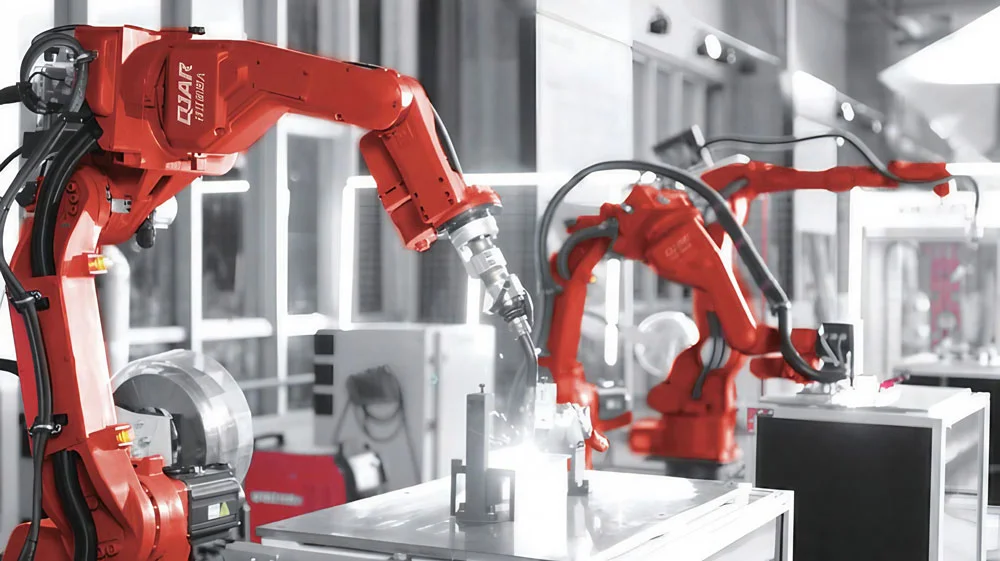
Consistent product quality
Welding robots ensure high precision, repeat operations according to the programmed schedule, thus when using automatic welding robots in the production process, it reduces errors due to worker skills. Product quality is consistent, meeting the stringent requirements of large orders for product accuracy.
Solving personnel issues
Many businesses face difficulties when personnel skills are uneven, and health is not guaranteed, leading to the inability to work continuously and not ensuring the quality of the products produced.
Welding robots, with their ability to work automatically, can work continuously with consistent welding quality, capable of performing difficult welding positions like 4F, 6G, etc., helping businesses solve the issue of personnel shortages.
Save production costs
Automatic welding robots reduce material consumption, save production costs, and limit errors and damage during the production process, such as workpiece punctures or material damage, especially when welding stainless steel or thin sheets.
3. Applications of automatic welding robots in production
Industrial welding robots are now widely applied in many production fields because they can perform welds from simple to complex, applicable in both civilian and heavy industries.
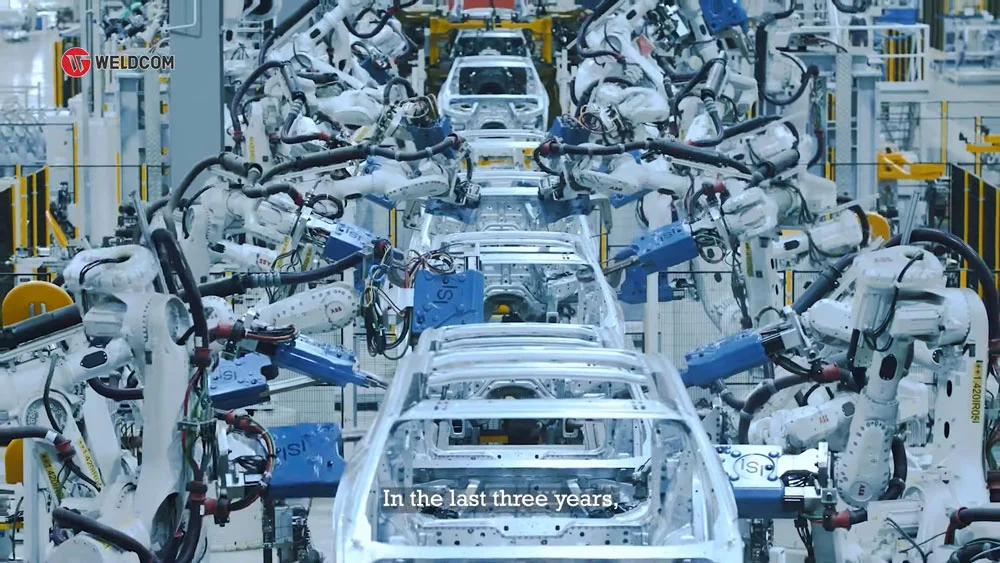
3.1. Application of automatic welding robots in the automotive and motorcycle industries
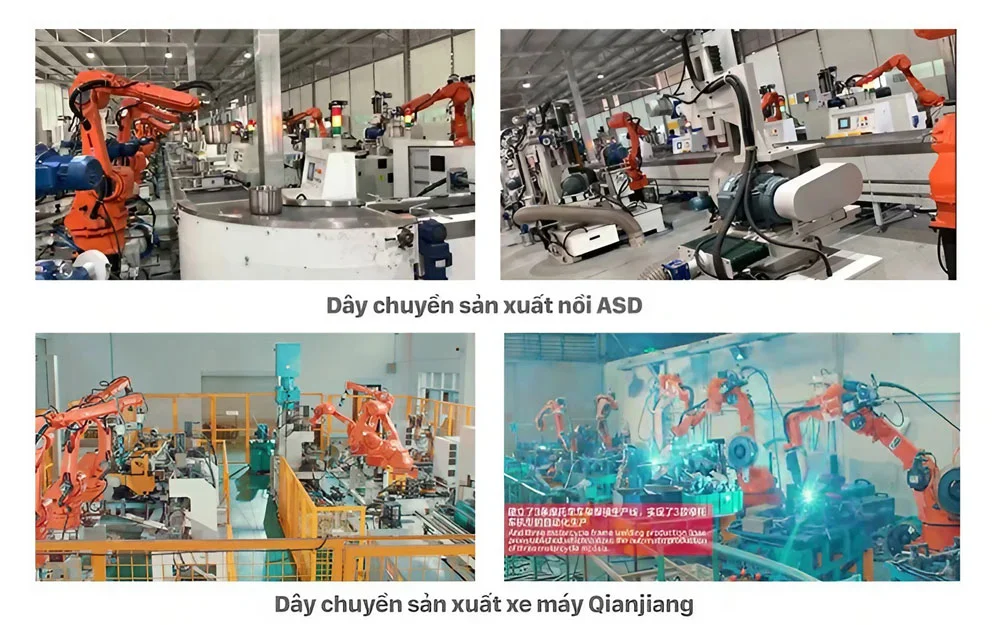
Welding robots have been involved in the welding process of vehicle frames, seat frames, hinges, and pipes from very early on.
For nearly 50 years, the automotive industry has continuously innovated, with major brands like Ford, Mercedes, Toyota, Honda, and Nissan using welding robots in 40% of the welding process.
3.2. Application of welding robots in metal furniture production
In the field of metal furniture production, the application of welding robots can be mentioned as: welding tables and chairs, railings, gates, doors, supermarket shelves, lockers, etc., for beautiful, aesthetic welds and consistency with a large number of products.
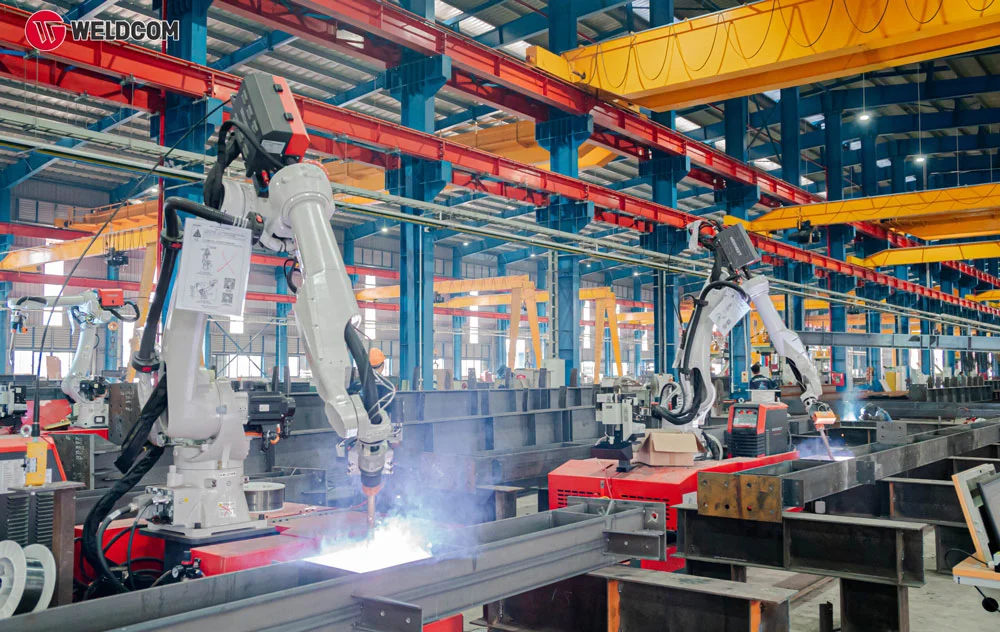
3.3. Welding robots applied in the steel structure and heavy machinery industries
High-power MIG/TIG welding robots are widely applied in the steel structure and heavy machinery industries as they can weld steel beams, factory frames, bridge structures, wind turbine towers, etc., ensuring productivity, accuracy, and safety when welding large-sized details.
3.4. Welding robots applied in the shipbuilding, oil, and energy industries
Welding robots are particularly effective with complex welds, large volumes, and harsh working environments, so they are applied in the welding process of ship hulls, tanks, high-pressure pipelines, drilling rig bases, wind turbine towers, etc.
3.5. Automatic welding robot solutions in the electronics, household, and consumer products industries
Laser welding robots provide beautiful, precise welds with minimal distortion, so they are applied to weld thin, small details requiring high aesthetics, such as batteries, electronic components, device casings, household appliances, etc.
4. Popular types of welding robots today
There are many types of welding robots today, depending on the classification criteria, they can be divided into different types. Here, Weldcom classifies welding robots according to the welding source as follows:
4.1. MIG welding robots
MIG welding robots are robots that use a MIG welding source. In this case, the welding method will be the MIG welding method with the principle of using a melting welding wire combined with protective gas (Argon, CO₂, or a mixture).
- Advantages: The MIG welding method has the advantage of high speed, high productivity, less slag, and easy automation.
- Applications: Welding steel structures, beams, frames, large mechanical products.
4.2. TIG welding robots
TIG welding robots are robots that use a TIG welding source. In this case, the welding method will be the TIG welding method with the principle of using a non-melting electrode (tungsten) and Argon protective gas.
- Advantages: With the TIG welding method, the welding robot will provide beautiful, shiny welds, with minimal spatter, and weld stainless steel and thin metals well.
- Applications: Manufacturing stainless steel equipment, food industry, medical, high-end household goods.
4.3. Spot welding robots
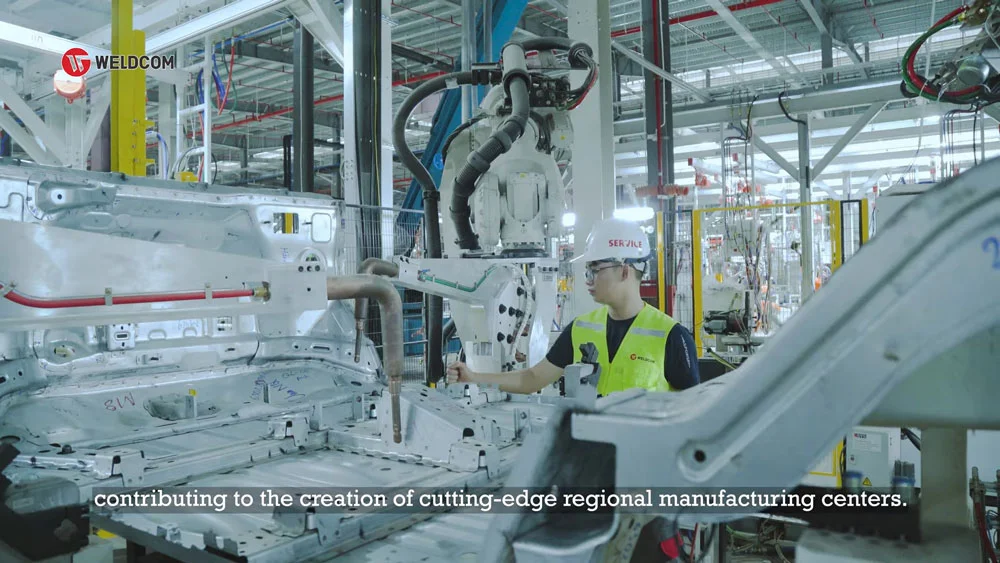
Spot welding robots use a large current to melt metal at the contact point.
- Advantages: Fast, precise, suitable for mass production.
- Applications: Automotive and motorcycle industries, especially in the production of vehicle frames.
4.4. Laser welding robots
Laser welding robots are robots that use a laser welding source. In this case, the welding method will be the laser welding method with the principle of using a high-power laser beam to create the weld.
- Advantages: The laser welding method provides extremely high precision welds, thin welds, and minimal thermal deformation.
- Applications: Electronics industry, battery production, thin metal details, requiring aesthetics.
5. Welding robots help solve the difficulties of large, medium, and small businesses
5.1. For large businesses
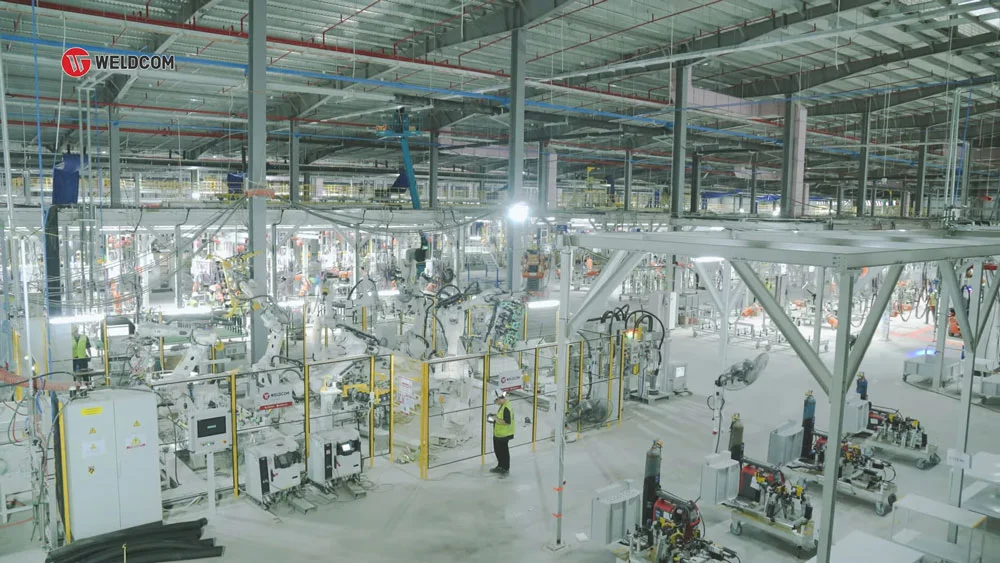
For large-scale businesses, where the production process is "in gear," the common difficulty is how to increase productivity, reduce working time, and increase product output without changing quality.
The difficulty in this situation is personnel. Experienced welders often do not work overtime, while young welders are prone to quitting uncontrollably.
Product quality depends heavily on the skills of the workers. While training a skilled welder takes a long time, once they have the skills, they tend to branch out and open their own workshops.
At that time, the automatic welding robot solution is the thorough solution to this problem.
5.2. For small businesses
Small-scale businesses are compact, flexible, and easily change and adjust business methods, while large businesses change models very slowly. Therefore, welding robots are a solution that businesses should not overlook.
Small-scale businesses can easily identify issues that need improvement in the production process, thereby thoroughly addressing them and increasing efficiency.
6. Comparison of traditional welding - robot welding
| Welder | Welding robot | |
| Weld quality | Inconsistent, dependent on the welder's skill | Consistent, highly accurate |
| Work productivity | 8h-10h/ day, many breaks | Can work 24h/ day, maintenance 1 day/year |
| Salary cost (with the above work productivity) | 1000 products/ month/ 4 welders => Salary cost 40 million (Average 10 million/ welder/ month). Each year spends 480 million on labor wages (excluding bonuses) | 1000 products/ month/ 1 robot => Initial investment about 400 million => Capital recovery after 1 year, subsequent years only incur maintenance costs. |
| Training time | Recruit or train a skilled welder => several weeks to several years | Quick machine setup in 24h. Operation training takes only 2h |
7. Real operational data experience of Weldcom welding robots in steel structure production
This is the actual data of Weldcom being deployed at a customer's factory with the application of welding 9m long steel structure beams.
Steel structure beams are a common product in steel structure factories. Beams often have many welds, many different welding positions with high stability requirements.
During actual operation, Weldcom measured:
- The process of scanning and creating a welding program takes about 10 to 15 minutes.
- The time for the welding robot to perform welding takes about 45 minutes.
- The total time to complete a 9m long steel structure beam is about 60 minutes
> With an 8-hour work shift, a welding robot can complete 7 to 8 beams.
When compared to the working time of a skilled welder, the time to complete a 9m long steel structure beam is about 50 minutes if working continuously without rest. This is a productivity that cannot be achieved in reality because welders cannot maintain this intensity throughout an 8-hour workday.
8. Official price quote for Robot welding machines distributed by Weldcom
"How much does a welding robot cost?" will be a concern for many businesses when considering the option of investing and applying this equipment in automated production.
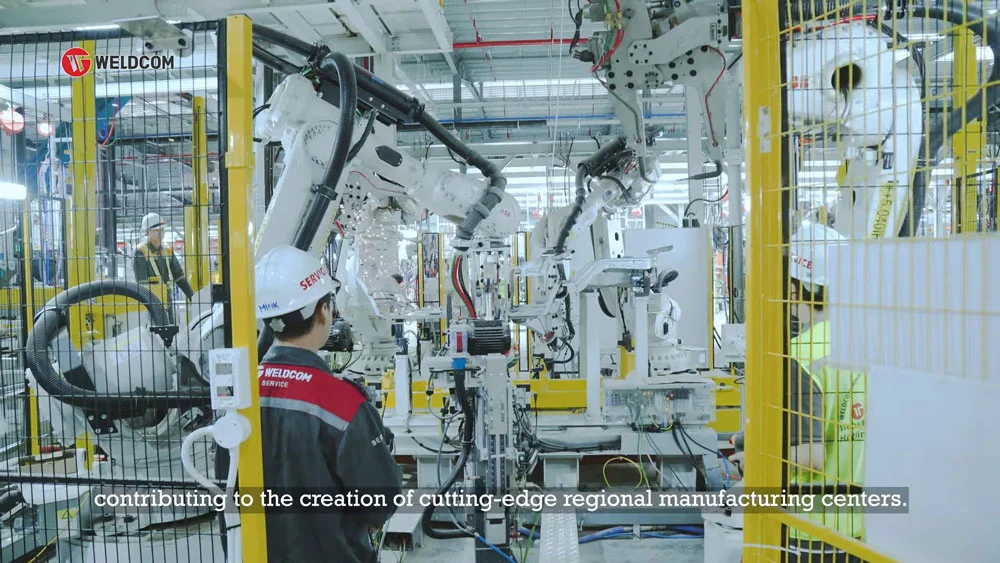
The price of automatic welding robots depends on the actual configuration of the business. The robot price will include the price of the robotic arm + welding source + robot base + torch cleaning station + ... Businesses that already own any components can reduce the actual investment cost.
A complete automatic welding robot costs from 400 million, including:
- The robotic arm has a reference price from 350 million
- The welding source has a reference price from 30 million
- The torch cleaning station has a reference price from 20 million
- The robot base has a reference price from 15 million
The price of automatic welding robots also changes according to many factors such as: robot reach, load capacity, MIG/MAG, TIG, or laser welding technology, jig requirements, automation level, etc.
Therefore, to receive the most accurate price quote with the production situation, needs, and business problems being faced, please contact Weldcom to receive an accurate automatic welding robot price quote, grasping the key to helping businesses break through and create a superior advantage even in the most difficult economic times.
Liên hệ