
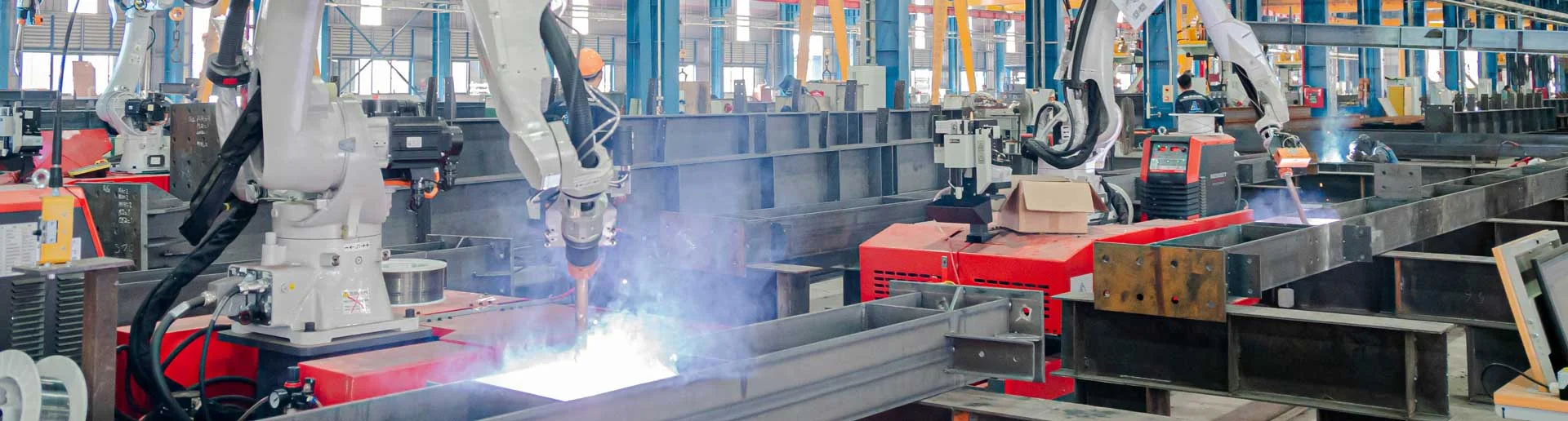
7-AXIS SUBMERGED ARC WELDING (SAW) ROBOT STATION SOLUTION HONGLU
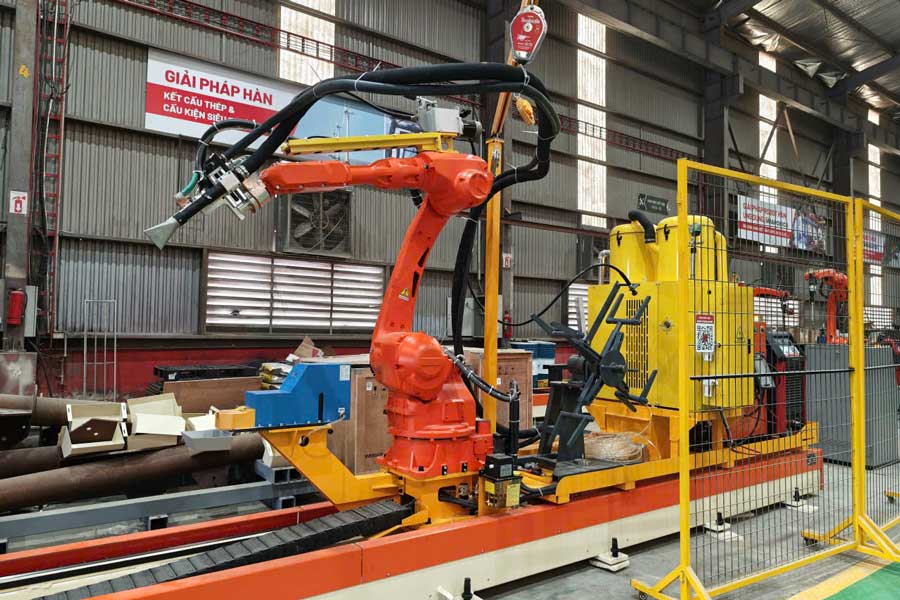
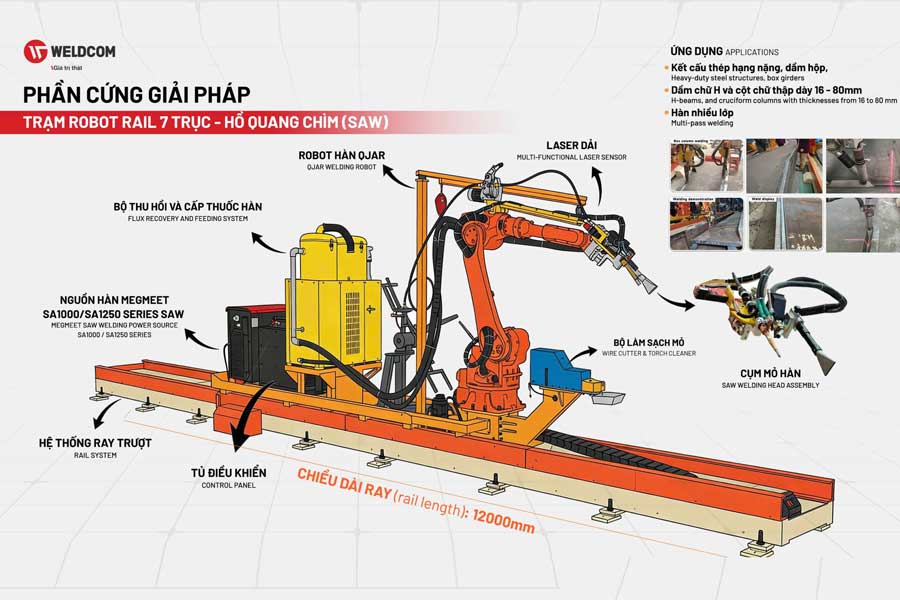
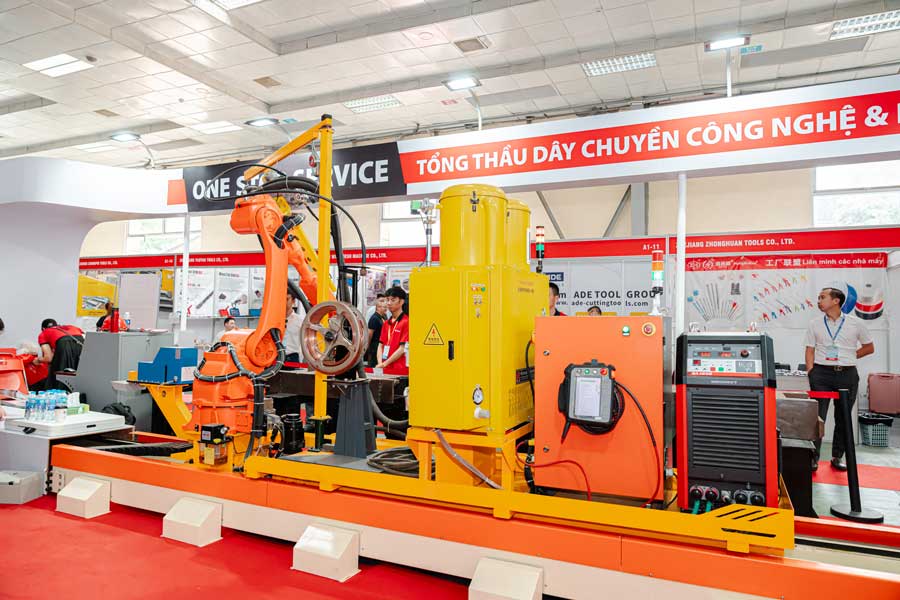
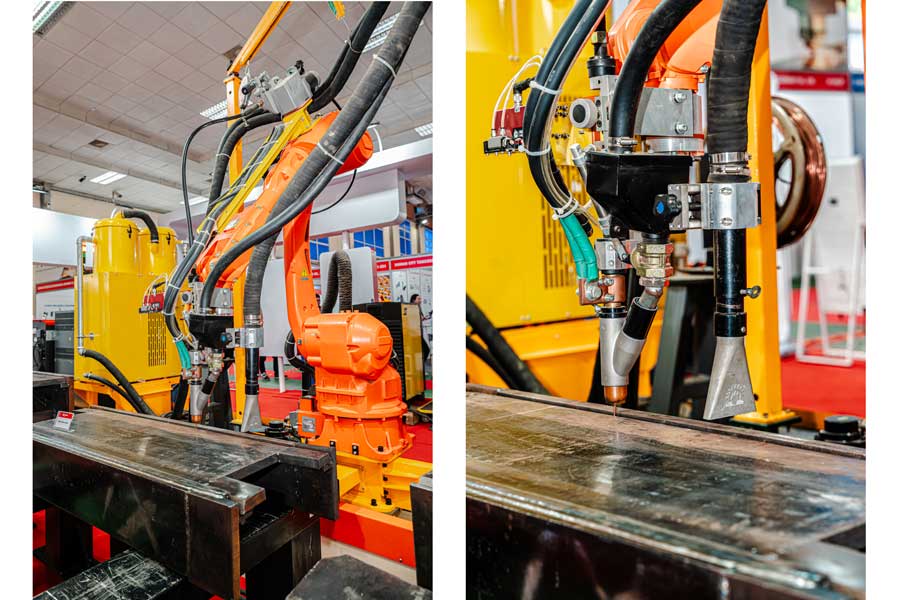
7-AXIS SUBMERGED ARC WELDING (SAW) ROBOT STATION SOLUTION HONGLU
- Fully supports deep welding for H beams, box columns, cruciform columns, and thick plate steel structures.
- Integrates groove laser scanning and point cloud data processing to automatically create welding programs.
- Supports multi-layer – multi-pass welding for single V, double V bevels, and fillet welds.
- No-teaching system with 1:1 3D simulation, automatic collision checking, and robot path optimization.
- Automatically supplies, retrieves, and reuses welding flux, reducing material loss and maintaining a clean working environment.
Main Features
Submerged Arc Welding (SAW) Robot Solution HONGLU
The Submerged Arc Welding (SAW) Robot Solution with HONGLU guiding rail is an intelligent automatic welding system specialized for the steel structure manufacturing industry, meeting the requirements for complete penetration welding on medium and thick plate structures.
The system uses a 6-axis industrial robot combined with a floor-mounted guiding rail, allowing for an extended working range and performing long, continuous welds with high stability. The solution is suitable for welding H-beams, box columns, cross columns, and steel structures with complex weld grooves.
The robot supports bottom layer, overlay, and cover layer welding for multi-layer – multi-pass welds, and also allows for straight welds, zigzag welds, and small radius arc welds.
Solution Combining Key Features
- Applies laser groove scanning technology and point cloud data processing to automatically identify bevel edges and create welding programs.
- 6-axis industrial robot combined with a 12 m guiding rail helps expand the machining range of large-sized steel structures.
- Supports full and partial penetration welding for H-beams, box columns, and cross columns.
- 7-axis submerged arc welding (SAW) robot station HongLu automatically creates multi-layer – multi-pass welding parameters for single V, double V bevels, and fillet welds.
- Supports welding steel with thickness from 16 mm to 80 mm.
- Integrates robot motion simulation and collision detection functions before actual operation.
- Laser weld tracking helps maintain the accuracy and stability of the weld throughout the working process.
- Digital communication with the welding source allows precise control of current, voltage, and welding speed.
- Integrates automatic welding flux feeding, recovery, and screening system.
- Connects to a cloud platform supporting remote monitoring of equipment status and welding data statistics.
- Software supports free upgrades and continuously updates the welding technology library.
Required floor area for standard station: 3 meters × 12 meters.
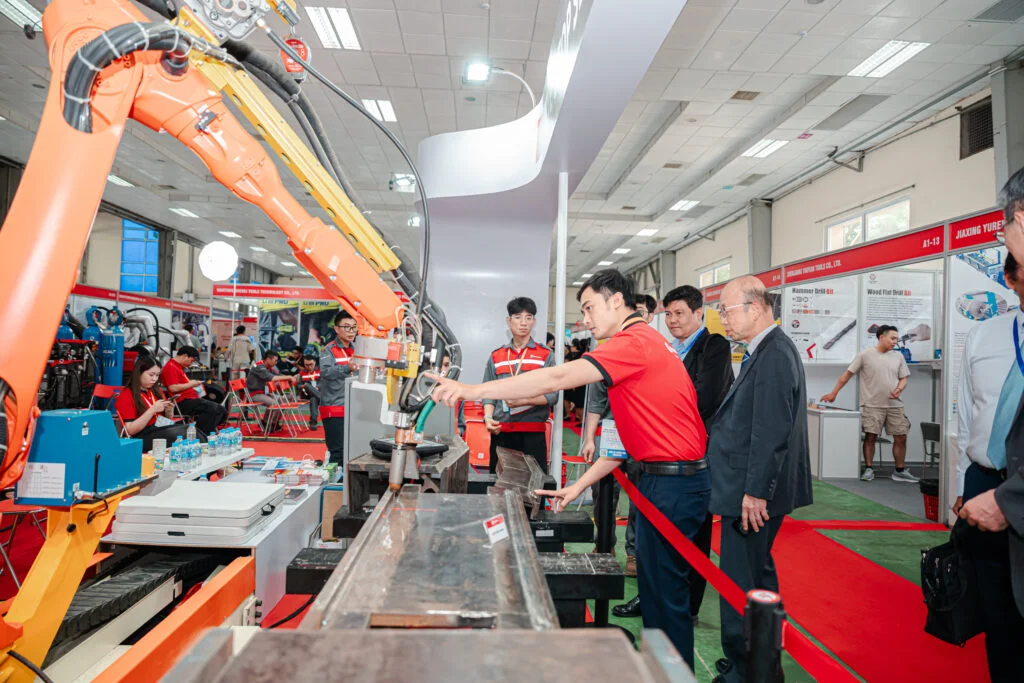
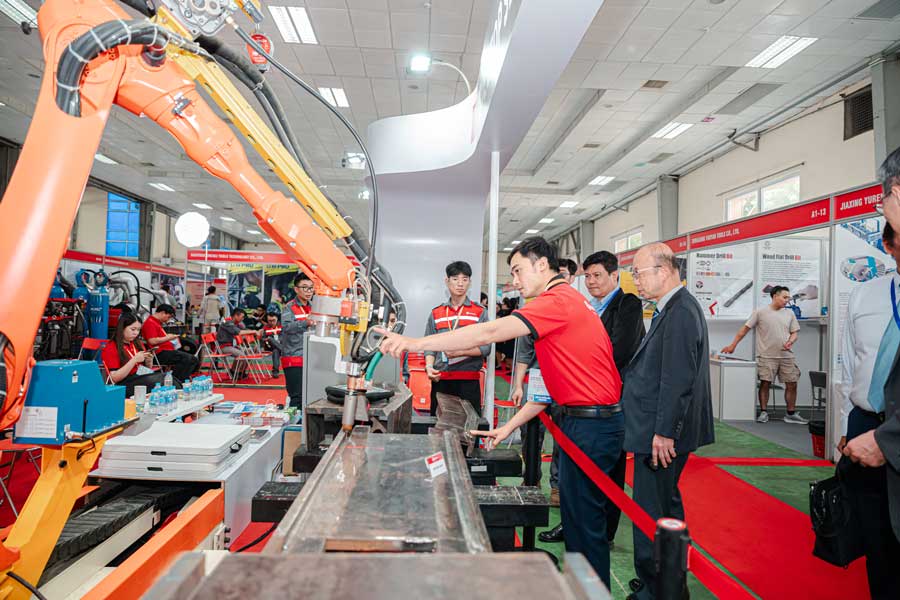
HONGLU SMART ROBOT OPERATING SYSTEM
The system is independently developed by Honglu, deeply integrating submerged arc welding processes with a vision system and specialized welding technology database.
The software uses actual scan data to identify weld grooves, analyze bevel sizes, calculate technology parameters, and automatically create suitable welding programs for each detail.
The entire system operates on an industrial computer (PC) platform, allowing remote control and monitoring of equipment via TCP/IP protocol.
1. Operating Principle – SEMI-AUTOMATIC WELDING MODE
(1) Operator selects the type of structure and weld groove form
The system supports H-beams, box columns with single V or double V grooves, and allows selection of pre-integrated welding technology parameters or manual editing.
(2) Record welding points and deviation calculation points
The robot records the start point, end point, and deviation calculation points to facilitate scanning and tracking of the weld path.
(3) Set welding speed
Allows setting a fixed welding speed or a variable speed according to each segment to ensure uniform weld surface.
(4) Create scanning and welding programs
The system automatically creates the weld groove scanning program and the actual welding program before sending it to the robot for operation.
(5) Robot executes the welding process
The robot performs scanning, accurately positioning the weld path, and executes the submerged arc welding process according to the created program.
2. Operating Principle – FULLY AUTOMATIC WELDING MODE
(1) Initialize and connect the system
Check the status of the robot, welding source, wire feeder, flux feeder, and camera system before operation.
(2) Rough positioning
The robot records the start and end positions of the weld groove to establish the working area.
(3) Laser scanning and point cloud data collection
The system scans the entire weld groove to collect actual geometric data.
(4) Automatic analysis and calculation of weld groove
The software automatically segments the weld groove, calculates width, depth, and groove angle to create suitable technology parameters.
(5) Simulation and collision detection
The robot performs a full motion simulation before welding to check accessibility and detect collisions.
(6) Create and send welding program
After safety verification, the system automatically sends the program to the robot to execute the welding process.
Core Technologies of the System
- No-teaching System: Accurate 1:1 3D simulation of robot motion, pre-calculation of welding cycle, and collision detection to reduce programming and setup time at the station.
- Dedicated Robot Controller for SAW: Integrates welding technology packages for medium and thick plates, supports laser tracking, arc tracking by current, and weld path positioning.
- Point Cloud Data Processing: Analyzes scan data to locate workpieces, identify weld grooves, and build reverse modeling for the automatic welding process.
- Laser Weld Groove Scanning: Automatically creates multi-layer – multi-pass welding parameters for steel structures with thickness from 16 mm to 80 mm.
- Laser Weld Path Tracking: Maintains the accuracy of the welding torch throughout the operation, reducing reliance on manual operations.
- Automatic Welding Flux Feeding and Recovery System: Automatically feeds, recovers, and reuses welding flux, reducing material waste and improving the working environment.
- Digital Connectivity and Cloud Platform: Allows monitoring of equipment status, operational data, and welding process statistics in real-time.
Technical Specifications of the 7-axis Submerged Arc Welding (SAW) Robot Station HongLu
Installation Dimensions: 13x3 meters/station | |||
| Software | |||
Intelligent control system includes: vision system, control software, and computer | |||
| Hardware | |||
Description | Unit | Technical Specifications | |
Laser Range Sensor | Laser center distance | mm | Precise positioning: 500 Rough positioning: 1000 |
| Horizontal resolution | mm | Precise positioning: 0.11 - 0.23 Rough positioning: 0.26 - 0.75 | |
| Depth resolution | mm | Precise positioning: 0.46 - 1.8 Rough positioning: 1.11 - 9.5 | |
Welding Robot QJR20-2000 (QJAR) | Reach | mm | 2002 |
| Repeatability | mm | ±0.05 | |
| Robot arm load capacity | kg | 20 | |
Welding Source SA-1250 (Megmeet) | Wire feeder drive control method | High-frequency feedback electromotive force control | |
| Rated output current | A | 100~1250 | |
| Duty cycle | 100% | ||
| Rated output voltage | V | 20 - 44 | |
Sliding Rail System | X-axis length | m | 12 |
| Load capacity | kg | 500 | |
| Error | mm | ±1 | |
| Maximum speed | m/min | 12 | |
Welding Flux Suction and Discharge System | Working negative pressure | Kpa | -16 ~ -38 |
| Recovery speed | L/min | 6 - 12 | |
| Capacity | L | 40 | |
Customers interested in the 7-axis submerged arc welding (SAW) robot station HongLu please contact Weldcom via hotline or leave your information for detailed support.
Consulting support

Please contact us!